

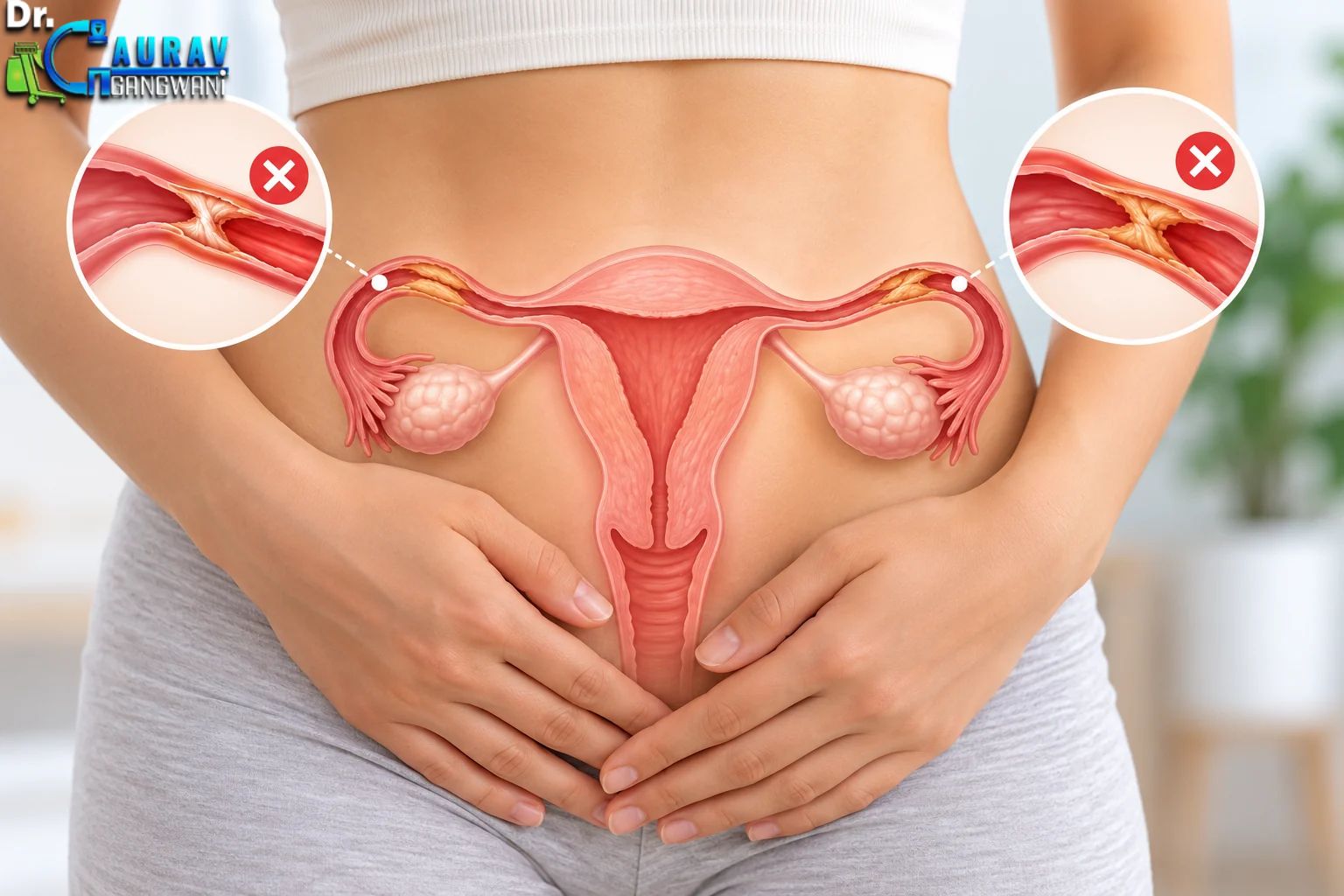
An HSG (hysterosalpingogram) report saying both tubes may be blocked is hard to read, especially after months of trying to conceive. Infertility is common: the WHO estimates that about one in six people of reproductive age experience infertility in their lifetime.
Bilateral tubal blockage is one possible cause, and a first report is not always the final word. This article covers what the finding means, how it is confirmed and which treatments may be considered.
The fallopian tubes connect the ovaries to the uterus. Fertilisation usually happens inside a tube, and the early embryo then travels to the uterus. If both tubes are confirmed to be completely blocked, natural conception by the usual route is extremely unlikely.
“Confirmed” is the key word. A report describing what one test showed on one day does not always establish permanent, complete obstruction.
Doctors may describe the finding as bilateral fallopian tube blockage or bilateral tubal occlusion. Either way, the wording describes what imaging suggests, and the next questions are where the blockage sits and how much damage surrounds it.
Causes of blocked fallopian tubes include pelvic inflammatory disease, earlier reproductive tract infections, scarring after pelvic surgery, endometriosis and previous ectopic pregnancy. Many people never knew they had an infection, and regular periods or the absence of pain do not rule out blockage.
An HSG uses contrast dye and X-rays to show whether dye passes through each tube. It can suggest a proximal blockage, near the uterus, or a distal blockage, near the ovary. A routine pelvic ultrasound cannot reliably show that the tubes are open.
However, the test has limits. Apparent proximal blockage can come from tubal spasm, uterine contractions or technical factors. A first result showing blockage does not always mean the tubes are permanently closed, which is why many doctors prefer to confirm it before planning treatment.
Depending on the case, a doctor may suggest a repeat HSG, contrast ultrasound, selective salpingography or laparoscopy, though few people need all of them. Our guide on blocked fallopian tube symptoms and diagnosis covers the tests in more detail.
Where the blockage sits changes the options. A blockage near the uterus may, in selected cases, be suitable for selective salpingography with tubal cannulation. A blockage near the ovary is usually harder to treat, because it often comes with adhesions or hydrosalpinx (a damaged tube filled with fluid). Clearing the uterine end of a tube cannot repair damage at the other end.
A proximal obstruction may be limited to the narrow uterine end of the tube, while distal damage often involves the far end and the surrounding adhesions. The two call for different approaches.
Fallopian tube recanalization is an image-guided procedure that uses a catheter, and sometimes a fine guidewire, to try to open selected obstructions, mostly near the uterus. It cannot treat every kind of tubal damage, and an open tube does not guarantee normal function, pregnancy or a live birth.
Surgery may be considered for certain adhesions or distal conditions, depending on the damage, age, ovarian reserve and other fertility factors. It carries a risk of ectopic pregnancy.
IVF bypasses the tubes altogether. Eggs are fertilised in a laboratory and an embryo is transferred to the uterus. IVF for blocked fallopian tubes may suit cases where damage is severe or repair is unlikely to help, though it never guarantees pregnancy. A fluid-filled tube can also affect IVF results, so some patients need that tube removed or blocked first.
Antibiotics can treat an active infection but cannot reverse established scarring.
Ask for the full report and images, not only the summary line. Find out whether one or both tubes are affected, whether the blockage looks proximal or distal, whether fluid is present and whether the result needs confirming.
It also helps to ask what each treatment could realistically achieve in your situation, what the risks are and how long it is reasonable to wait before choosing.
Then look at the wider picture: age, ovarian reserve, ovulation, uterine health and a semen analysis. Infertility is never one person’s responsibility alone, and the tubal finding does not settle the whole plan. If bilateral tubal blockage is confirmed, these factors will help decide between repair and IVF.
The next step depends on what is actually found in each tube, not on the wording of an early report. Some people have open tubes on repeat testing, some need treatment aimed at one specific blockage, and some are better served by moving straight to IVF. A specialist can review the images and explain which applies to you. If your blockage is near the uterus, you can consult Dr. Gangwani’s Vascular Clinic in Mumbai to find out whether recanalization is suitable.
If both tubes are confirmed completely blocked, natural pregnancy is extremely unlikely because egg and sperm cannot meet. A suspected blockage on a first HSG is different, since it may be partial or temporary.
Yes. Tubal spasm, uterine contractions or technical factors can make a proximal blockage appear when none exists. Doctors may repeat the test or use another method before recommending treatment.
It may be attempted on each side when the obstruction is suitable, usually near the uterus. Results depend on the type and location of the blockage, and open tubes do not guarantee pregnancy.
No. IVF may be more suitable when tubal damage is severe or other fertility factors are present, but selected patients may first consider tubal treatment. The choice is individual.
Tubal disease itself raises the risk, and a tube that has been treated may still not work normally. Early pregnancy monitoring is generally advised after a positive test.
This article is for general information and does not replace a medical consultation.
Dr. Gangwani Vascular Clinic, 302/TGN SQUARE 3rd floor Chandawarkar lane Borivali west Mumbai 400092
+91 9326195964
drgauravgangwani@gmail.com
Monday to Saturday: 8.30 am to 8.00 pm. For any quires & assistance please call on: +91 9082394787
Copyright 2026 – www.drgauravgangwani.com
Website Managed by SEO Discovery
WhatsApp us