
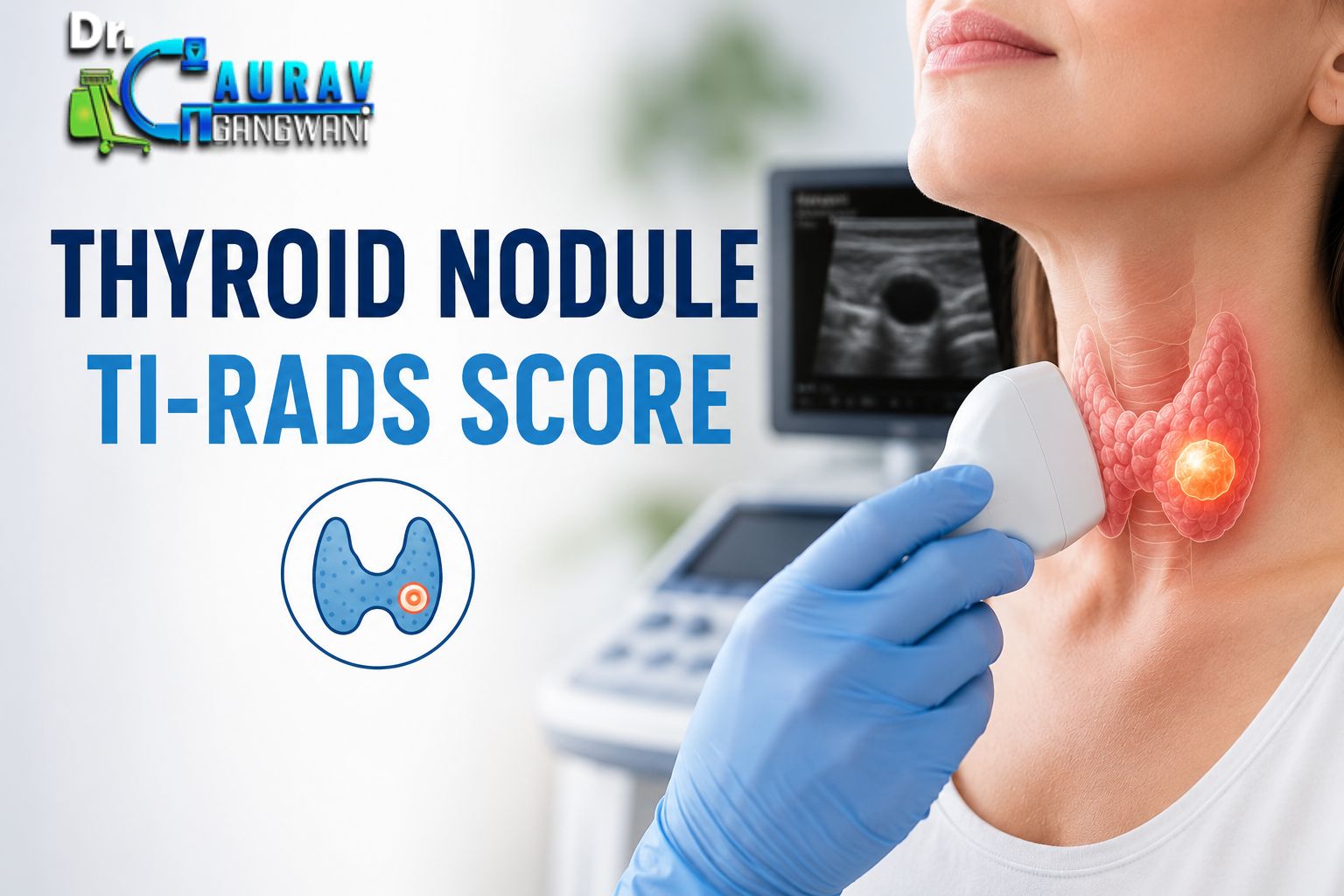
A Thyroid Nodule TI-RADS Score is a grading system doctors use to evaluate thyroid nodules seen on an ultrasound. It estimates how likely a nodule is to be cancerous and helps determine whether it only needs monitoring or should be examined further with a biopsy. Most thyroid nodules are benign, and the TI-RADS score helps ensure patients receive the right care without unnecessary procedures.
Hearing that you have a thyroid nodule can be worrying, but most thyroid nodules are non-cancerous and do not cause serious health problems. Doctors use the Thyroid Nodule TI-RADS Score to evaluate a thyroid nodule using ultrasound images and estimate its level of risk.
Based on the score, doctors can decide whether the nodule only needs routine follow-up or requires additional testing, such as a Fine Needle Aspiration (FNA) biopsy.
At Dr. Gangwani’s Vascular Clinic, patients receive clear explanations of their thyroid ultrasound results, helping them understand their condition and the next steps in their care.
The Thyroid Nodule TI-RADS Score gives doctors a standardized way to evaluate thyroid nodules, making diagnoses more accurate and consistent. It helps reduce confusion and ensures patients receive the most appropriate care.
The score helps doctors:
This structured approach helps identify nodules that need further evaluation while avoiding unnecessary procedures for benign ones.
TI-RADS stands for Thyroid Imaging Reporting and Data System.
It is a standardized classification system developed to help radiologists evaluate thyroid nodules in a consistent way. During a thyroid ultrasound, several features of the nodule are carefully examined. Each feature is assigned points based on how suspicious it appears.
These points are then added together to create the final Thyroid Nodule TI-RADS Score.
Rather than giving a simple “normal” or “abnormal” result, the score provides more detailed information about the level of concern and whether additional testing is necessary.
This system helps doctors communicate clearly with one another while giving patients more confidence in their diagnosis.
A TI-RADS score is based entirely on what the thyroid nodule looks like during an ultrasound.
Radiologists carefully evaluate several ultrasound characteristics before assigning points.
These include:
Each feature receives a certain number of points depending on how suspicious it appears.
After adding all the points together, the radiologist assigns the appropriate TI-RADS category. The higher the total score, the greater the level of suspicion. However, it is important to remember that even nodules with higher scores are not always cancerous.
The TI-RADS system is divided into five categories. Each category represents a different level of risk.
This category means there is no thyroid nodule present.
No additional evaluation is usually necessary because the thyroid appears normal on ultrasound.
A TI-RADS 2 nodule has ultrasound features that strongly suggest it is not cancer.
These nodules usually do not require a biopsy. In many cases, no additional treatment is needed unless symptoms develop or the nodule changes over time.
A TI-RADS 3 nodule has a very low risk of cancer.
Doctors often recommend monitoring these nodules with periodic ultrasounds instead of performing an immediate biopsy. If the nodule grows larger or develops new suspicious features, additional testing may then be considered.
A TI-RADS 4 nodule has several ultrasound features that deserve closer attention.
Depending on its size, your doctor may recommend a Fine Needle Aspiration biopsy to collect a small sample of cells for laboratory testing.
Many TI-RADS 4 nodules are still found to be benign after biopsy.
TI-RADS 5 indicates the highest level of concern based on ultrasound findings.
These nodules often require a biopsy because they have multiple suspicious characteristics. Even so, a TI-RADS 5 score does not automatically mean cancer. Only a biopsy can confirm the diagnosis.
No.
One of the biggest misunderstandings about the Thyroid Nodule TI-RADS Score is that a higher score automatically means thyroid cancer. That is not true.
The score only estimates the level of suspicion based on ultrasound images.
Many people with higher TI-RADS scores receive biopsy results showing that their thyroid nodules are completely benign.
Doctors always consider several factors before making a diagnosis, including:
Looking at all of this information together provides the most accurate diagnosis.
Not every thyroid nodule requires a biopsy.
The decision depends on both the TI-RADS category and the size of the nodule. A small nodule with suspicious features may still only need monitoring, while a larger nodule may require further evaluation.
A biopsy may be recommended if:
A Fine Needle Aspiration biopsy is a simple outpatient procedure that usually takes only a few minutes.
A thyroid ultrasound is one of the safest and easiest imaging tests available.
It does not involve radiation and is completely painless.
During the examination, a technician places a small amount of gel on the front of your neck and moves an ultrasound probe over the thyroid gland. The sound waves create detailed images that allow the radiologist to examine the thyroid tissue and any nodules present.
The procedure usually takes between 15 and 30 minutes.
Once the images are reviewed, the radiologist assigns the appropriate Thyroid Nodule TI-RADS Score based on the ultrasound findings.
Yes.
A thyroid nodule is not always the same throughout life. Some nodules remain stable for many years, while others slowly grow or develop new ultrasound features.
Because of this, your doctor may recommend regular follow-up ultrasounds.
Changes that may affect the TI-RADS score include:
Regular monitoring helps doctors detect these changes early and decide whether additional evaluation is needed.
Receiving your thyroid ultrasound report is only one step in the evaluation process.
Instead of worrying about the number itself, discuss the findings with your healthcare provider and understand what they mean for your individual situation.
You should:
Most thyroid nodules remain harmless and never require surgery. Regular follow-up is often the safest approach.
Understanding your Thyroid Nodule TI-RADS Score can help reduce unnecessary worry. The score is designed to guide medical decisions, not to predict your future with certainty. Many thyroid nodules are benign, and many patients only need routine monitoring rather than treatment.
If you have been diagnosed with a thyroid nodule or have questions about your ultrasound report, Dr. Gaurav Gangwani can explain your results, discuss your individual risk, and recommend the most appropriate next steps.
At Dr. Gangwani’s Vascular Clinic, every patient receives personalized guidance and evidence-based care to support informed decisions and long-term thyroid health.
1. What is a Thyroid Nodule TI-RADS Score?
A Thyroid Nodule TI-RADS Score is a standardized grading system used to evaluate thyroid nodules on ultrasound. It helps doctors estimate the risk of cancer and determine whether monitoring or a biopsy is needed.
2. Is a TI-RADS 3 thyroid nodule cancer?
No. Most TI-RADS 3 nodules are benign. They usually have a low risk of cancer and are commonly monitored with follow-up ultrasounds instead of immediate biopsy.
3. Does a TI-RADS 5 score always mean thyroid cancer?
No. A TI-RADS 5 score indicates a higher level of suspicion, but only a biopsy can confirm whether a thyroid nodule is cancerous.
4. How often should a thyroid nodule be checked?
The follow-up schedule depends on the TI-RADS category, the size of the nodule, and your doctor’s recommendation. Some nodules need yearly ultrasounds, while others require less frequent monitoring.
5. Where can I get guidance about my thyroid ultrasound results?
If you have questions about your thyroid ultrasound or TI-RADS score, Dr. Gaurav Gangwani and the team at Dr. Gangwani’s Vascular Clinic can help explain your results and recommend the most appropriate next steps based on your individual condition.
Dr. Gangwani Vascular Clinic, 302/TGN SQUARE 3rd floor Chandawarkar lane Borivali west Mumbai 400092
+91 9326195964
drgauravgangwani@gmail.com
Monday to Saturday: 8.30 am to 8.00 pm. For any quires & assistance please call on: +91 9082394787
Copyright 2026 – www.drgauravgangwani.com
Website Managed by SEO Discovery
WhatsApp us