

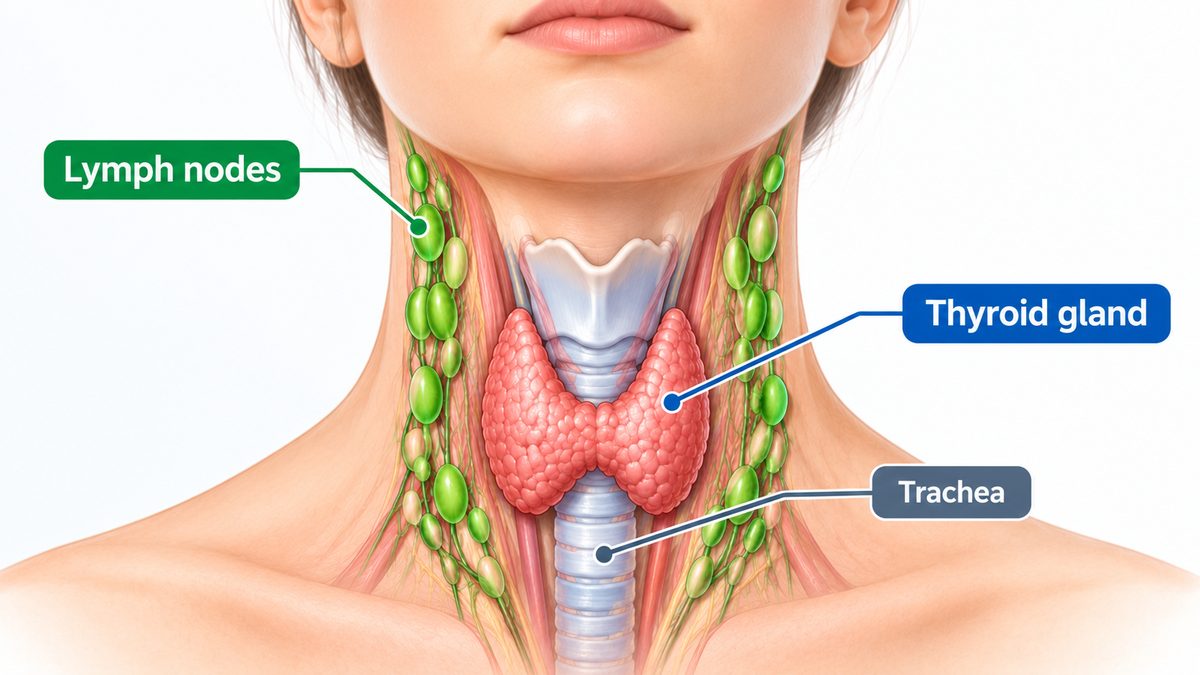
Enlarged lymph nodes near the thyroid have several possible causes, from throat infections to inflammatory thyroid conditions. Certain clinical or imaging features warrant further assessment for thyroid cancer or another serious condition, but enlargement alone cannot establish the cause.
If you have found a lump in your neck or read “lymph nodes” in an ultrasound report, the uncertainty is understandable. People search for thyroid lymph nodes because the report never explains the term.
A lymph node and a thyroid nodule are different structures. Below, you’ll see how doctors tell them apart, which ultrasound features matter, and when to get checked.
No. A thyroid nodule is a lump inside the thyroid gland, which sits low at the front of the neck.
Lymph nodes are small immune filters spread through the neck. Those that drain the gland and surrounding tissue are called cervical lymph nodes.
People often describe them as thyroid lymph nodes, which is a fair way to say where they sit. It is not a diagnosis.
The difference changes the next step. A nodule is judged on its features, while a node is judged by its appearance and by what the thyroid shows.
A lump at the front of the neck may be a nodule, a node, or another structure, and an ultrasound can often sort that out.
Reactive nodes are a common explanation. They swell while the body fights an infection such as a sore throat, a cold, or a dental problem, and they typically settle afterwards.
Other possibilities include:
A common cause is not a safe assumption. A node that persists or looks unusual deserves assessment, however likely an infection seems.
Symptoms alone cannot name the cause. That takes history, examination, and, where needed, imaging.
A thyroid ultrasound, or a neck scan covering the lymph nodes, shows a node’s size, shape, and internal structure.
Healthy nodes tend to be oval with a central band of fat called the hilum. Losing that band is one reason a node gets a second look.
Doctors look more closely when a node is rounded, has lost its hilum, contains cystic areas, tiny bright specks, or calcifications, or shows disorganised blood flow. Location also counts.
No single feature settles the diagnosis. Node features are read alongside the thyroid findings, your history, and other results, and size is only part of the picture.
A report calling a node suspicious means it deserves a closer look. It does not mean cancer is confirmed.
ACR TI-RADS, often quoted in reports, grades thyroid nodules. It is not a scoring system for lymph nodes.
Arrange an assessment if a lump:
Neither pain nor its absence proves a node is harmless or harmful. Feeling otherwise well does not rule out a problem.
There is no need to press or measure the lump yourself.
Difficulty breathing, or neck swelling that develops quickly, needs urgent medical attention.
The initial steps in assessment are your history and neck examination. Your doctor may ask about recent infections, dental problems, weight changes, and how long the lump has been there.
Whether ultrasound or other tests are needed depends on what those show. A node that fits a recent infection may simply be watched.
Blood tests show how the thyroid is working, not what a lump is. Normal results do not rule out a worrying node or nodule. If features look suspicious, fine-needle aspiration collects cells with a thin needle, usually guided by ultrasound. The sample is then examined under a microscope.
This means the shortest dimension is considered only when the result would change management. It is not a rule for every swollen neck node. The same guideline allows smaller suspicious nodes to be followed unless they grow or threaten nearby structures.
Treatment follows the cause: monitoring for reactive nodes, antibiotics for a bacterial infection, and specialist cancer treatment if cancer is confirmed.
Usually not. Reactive nodes are common and often shrink once an infection passes. A node that persists, grows, or looks suspicious on ultrasound should still be investigated.
Yes. Inflammatory conditions such as Hashimoto’s thyroiditis can be linked to enlarged nodes, and thyroid cancer can involve them. Thyroid blood tests alone cannot tell which is happening.
It can raise or lower suspicion, but it cannot confirm the cause by itself. A needle sample provides more information when it is needed.
No. Many nodes are watched or treated for their cause. A biopsy is considered when findings are suspicious, and the result would guide care.
If a lump has lingered or a report has left you with questions, a clinical assessment is a sensible next step. Bring any ultrasound report with you.
You can arrange a consultation with Dr Gaurav Gangwani to have your findings reviewed.
Dr. Gangwani Vascular Clinic, 302/TGN SQUARE 3rd floor Chandawarkar lane Borivali west Mumbai 400092
+91 9326195964
drgauravgangwani@gmail.com
Monday to Saturday: 8.30 am to 8.00 pm. For any quires & assistance please call on: +91 9082394787
Copyright 2026 – www.drgauravgangwani.com
Website Managed by SEO Discovery
WhatsApp us