

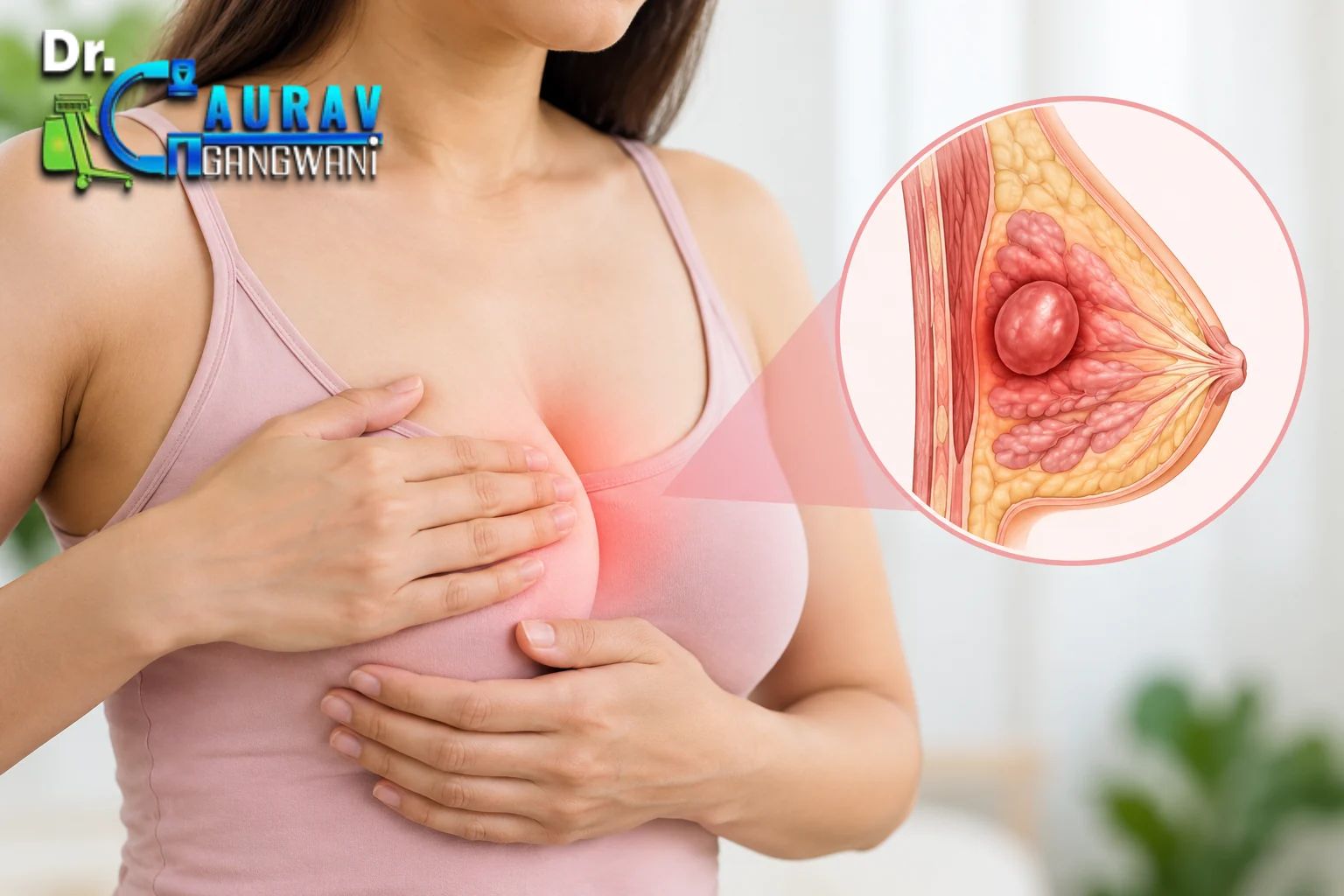
Finding a movable lump in the breast with no pain can be unsettling precisely because nothing hurts. There is no obvious reason for it, and it is hard to know how seriously to take it.
Breast health deserves attention: an estimated 2.4 million women were diagnosed with breast cancer globally in 2024. It says nothing about the chance that your lump is cancer, and most breast lumps are not cancer. Still, nobody can tell which kind of lump you have by feeling it, and that includes you and your doctor.
Several harmless conditions can produce a painless breast lump.
A fibroadenoma is a benign solid growth of glandular and connective tissue. It often feels firm or rubbery, smooth and easy to move, and it is usually painless. Fibroadenomas are most common in younger women but can appear at any age.
A breast cyst is a fluid-filled sac. Depending on its depth and how full it is, it may feel soft or hard and tense, and it can change size through the menstrual cycle.
Hormone-related or fibrocystic changes can make breast tissue feel lumpy, often more so before a period. A lipoma, a soft lump of fat, is another possibility.
Breast cancer is the possibility touch cannot exclude. These descriptions are general patterns, not a way to identify a lump at home.
No. Mobility describes how a lump behaves under the skin, not what it is made of. Many benign lumps glide easily, but some cancers can also feel smooth, soft and mobile, particularly when small.
Pain is no better a guide, because breast cancer is frequently painless. If your lump is tender, our guide to a painful lump in the breast covers the causes and tests in that situation.
Shape, size, texture and comfort cannot settle the question. A lump that feels reassuring may still need imaging, and one that feels alarming may turn out to be harmless.
Arrange an assessment for any new or unexplained breast lump, even if it moves freely and does not hurt. You do not need other symptoms to justify an appointment, and there is no reason to hold off until the lump grows or becomes painful.
Seek prompt assessment if you also notice:
Redness, warmth, fever or marked tenderness point towards infection rather than a typical painless lump, and that needs treatment too. No list of signs can tell you whether a lump is cancerous. Use them as a reason to hurry, not as a way to self-diagnose.
Assessment starts with a conversation and an examination. The clinician will ask when you found the lump, whether it has changed and about your age, family history and hormonal factors, then examine both breasts and the armpits.
Imaging is chosen according to age and what the examination finds. A breast ultrasound uses sound waves and is particularly good at telling a fluid-filled cyst from a solid mass. Diagnostic mammography is an X-ray used to investigate a specific problem. It differs from screening mammography, which is offered to people with no symptoms. Whether it is needed depends on age and the clinical picture, and in younger women ultrasound is often the first test.
When imaging is not enough, a biopsy may be recommended. Fine-needle aspiration draws out fluid or cells through a thin needle, while a core needle biopsy takes small tissue samples for laboratory examination.
Not everyone needs every test. A simple cyst confirmed on ultrasound may need no biopsy, for instance. Results are always read alongside the examination, and a lump that still worries the doctor can warrant further assessment even after a reassuring scan.
A benign result does not mean the lump has to come out. There are three broad paths.
A biopsy exists to make a diagnosis; removing a lump is a separate decision with a different purpose.
For selected benign lesions, such as some fibroadenomas, vacuum-assisted excision may be an option. Suitability depends on the lump’s size, imaging and biopsy results, and the procedure carries risks such as bruising and bleeding. It is not the right choice for every lump.
Arrange a clinical assessment for any new or unexplained breast lump, even if it moves easily and does not hurt. The diagnosis should come first and should guide what happens next, because some lumps only need watching, some need sampling and a few need removal.
At our practice, we assess breast lumps with imaging and image-guided sampling, and we discuss options that suit the diagnosis and the patient’s circumstances, including whether any treatment is needed at all.
Yes. Most breast lumps are benign, but movement and lack of pain do not rule out cancer. Only examination and imaging can tell.
No. It depends on the examination and imaging. A simple cyst on ultrasound may need none, while a solid lump or uncertain findings often lead to one.
No. Once the diagnosis is confirmed, many are simply monitored. Removal is considered if the lump grows, causes symptoms, has uncertain findings, or the patient prefers it. When removal is chosen, non-surgical fibroadenoma treatment may be suitable for selected lumps.
Yes. A stable size does not show that a lump is harmless, and a new lump should be assessed whether or not it changes.
A GP or a breast clinician is a sensible starting point. They can examine you, arrange imaging and refer you to a specialist if sampling or further assessment is needed.
This article is for general information and does not replace a medical consultation.
Dr. Gangwani Vascular Clinic, 302/TGN SQUARE 3rd floor Chandawarkar lane Borivali west Mumbai 400092
+91 9326195964
drgauravgangwani@gmail.com
Monday to Saturday: 8.30 am to 8.00 pm. For any quires & assistance please call on: +91 9082394787
Copyright 2026 – www.drgauravgangwani.com
Website Managed by SEO Discovery
WhatsApp us