

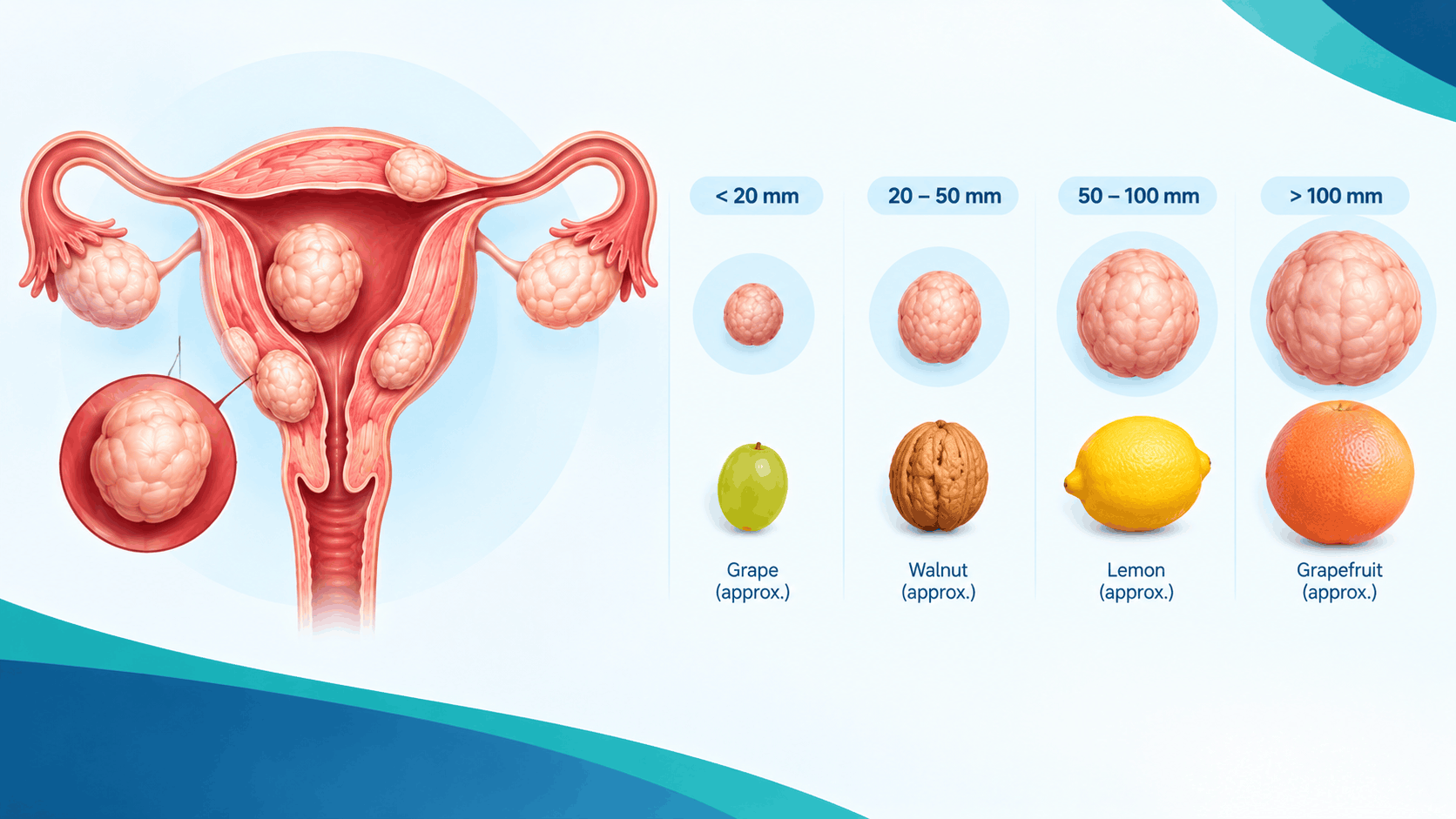
No single measurement makes a fibroid dangerous. Still, doctors often start paying closer attention once a fibroid passes roughly 50 mm, and one above about 100 mm commonly causes pressure problems you can’t ignore. Therefore, the true answer to the question of what size fibroid is harmful in millimeters relies on the combination of size, location, and symptoms. Here’s something reassuring to start with: the Office on Women’s Health says about 20 to 80 per cent of women develop fibroids by age 50, and most never have trouble. Keep reading, because the number on your scan only tells half the story.
Nope, and that surprises most people. Fibroids are non-cancerous growths composed of the uterine wall’s muscle and connective tissue. They vary a lot in size, shape and location. A 30 mm fibroid inside the uterine cavity can cause heavy periods, while a 60 mm one on the outer wall might cause nothing at all. Location and symptoms matter just as much as millimetres.
That’s why you can’t judge which size of fibroid is dangerous in mm by the number alone. Smaller fibroids often need no treatment, and doctors simply keep an eye on them.
Usually with an ultrasound, sometimes an MRI. The report lists each fibroid’s diameter in millimetres or centimetres (10 mm equals 1 cm). Some doctors also compare fibroids to a pregnancy. You might hear that your fibroids make your uterus the size it would be at 16 weeks of pregnancy.
Numbers feel abstract, so here’s a rough guide. These bands are general rules of thumb, not strict medical cut-offs.
| Size in mm | Everyday comparison | What it usually means |
| Under 20 mm | Grape or smaller | Often no symptoms; doctors usually just monitor |
| 20 to 50 mm | Walnut to golf ball | Symptoms depend on location; many need no treatment |
| 50 to 100 mm | Lemon to small grapefruit | Pressure and heavy bleeding become more likely |
| Over 100 mm | Grapefruit or bigger | Can enlarge the belly and press on organs |
Most women in this range feel nothing. If a fibroid sits inside the uterine cavity, it can still cause heavy bleeding, so don’t write it off just because it’s small. Without symptoms, you usually don’t need treatment.
At this point, ladies begin to inquire about the harmful fibroid size in millimeters, and with good cause. Larger fibroids press on nearby organs. That can mean frequent urination, lower back discomfort, painful sex and a fuller lower belly.
At this size, a fibroid can make your abdomen swell until you look pregnant. It rarely causes harm overnight, but it usually deserves a proper treatment plan instead of “wait and see.” If you’re in this range, don’t panic. Just don’t put off the conversation with your doctor either.
Here’s the reassuring part: fibroids are almost always benign. The Office on Women’s Health puts the chance of a cancerous one at less than one in 1,000. Even so, if you notice a fibroid suddenly growing fast, mention it to your doctor so they can take a closer look.
Honestly, your symptoms tell you more than the millimetres do. Watch for:
Here’s a made-up but very common scenario. A woman finds a 45 mm fibroid on a routine scan and panics. She has no symptoms, so her doctor simply schedules follow-up checks. Another woman has a 40 mm fibroid in the uterine cavity and bleeds heavily every month. She needs help sooner. Same ballpark size, totally different situations. Therefore, consider how you really feel before becoming fixated on the size of fibroid that is harmful in millimeters.
Confused about your scan report? Book a consultation with Dr Gaurav Gangwani at Dr Gangwani’s Vascular Clinic, and we’ll explain your fibroid’s size, location and options in simple terms. Book an appointment.
Yes, in many cases. Fibroid treatment without surgery has become a real option for women who want relief without a hysterectomy. Once you know which size of fibroid is dangerous in mm for your situation, what comes next? You have real options.
We recommend uterine fibroid embolisation (UFE). An interventional radiologist performs it on an outpatient basis. The doctor threads a tiny catheter through an artery in the wrist or groin to the vessels feeding your fibroids, then injects small particles that cut off their blood supply. Starved of blood, the fibroids shrink. Here’s what makes it appealing:
Fibroids shrink gradually over weeks to months, and most women feel relief from heavy bleeding and pelvic pressure along the way. Doctors have used uterine fibroid embolisation for more than 20 years. Because everybody differs, we also suggest getting an interventional radiologist’s opinion before you decide.
Consider 50 mm as the starting point for observation and 100 mm as the planning point. Your symptoms, the fibroid’s location, and your pregnancy plans make the final call. If you still wonder which size of fibroid is dangerous in mm for your own scan, bring your report to someone who’ll explain it honestly.
That’s what we do at Dr Gangwani’s Vascular Clinic in Borivali West, Mumbai. Dr Gaurav Gangwani, an interventional radiologist with 10+ years of experience, walks you through risks, recovery, and every option, including fibroid treatment without surgery, so you decide. Call +91 9082394787 (Monday to Saturday, 8:30 am to 8 pm) or book online today.
There’s no magic millimetre number, and that’s actually good news, because it means your doctor looks at you and not just your scan. They weigh your symptoms, where the fibroid sits, how fast it’s growing and whether you want to get pregnant. A 40 mm fibroid causing heavy bleeding may need treatment, while a 70 mm one with no symptoms may just need monitoring. And if someone recommends a hysterectomy, it’s smart to get a second opinion from an interventional radiologist, because a non-surgical option might fit you better.
Sometimes they do. Fibroids run on hormones, so they usually shrink once you reach menopause. On the flip side, they can grow quickly during pregnancy, when hormone levels climb. If you’re still having periods, though, don’t count on them disappearing by themselves. Keep up with your checkups so your doctor can track any changes.
It can, but please don’t worry too much, because most women with fibroids have normal pregnancies. The Office on Women’s Health does note a higher chance of cesarean delivery, a breech baby or preterm delivery. Embolisation aims to preserve the uterus and reproductive function, and many patients go on to conceive afterwards. If you’re planning a pregnancy, tell your doctor before choosing any treatment so they can match the approach to your goals.
Almost never. Fibroids are benign, and a cancerous one shows up in fewer than one in 1,000 cases. Having fibroids also doesn’t raise your risk of other uterine cancers. Still, if a fibroid grows rapidly or you bleed after menopause, get it checked promptly, just to be safe.
If it causes no symptoms, usually nothing happens, and your doctor just keeps monitoring it. If it does cause symptoms, heavy bleeding can lead to anaemia, and the pressure can irritate your bladder and back. These problems tend to build slowly, which means they’re easy to put up with for years. Treating them earlier often makes recovery easier, so you don’t have to wait until life feels miserable.
Dr. Gangwani Vascular Clinic, 302/TGN SQUARE 3rd floor Chandawarkar lane Borivali west Mumbai 400092
+91 9326195964
drgauravgangwani@gmail.com
Monday to Saturday: 8.30 am to 8.00 pm. For any quires & assistance please call on: +91 9082394787
Copyright 2026 – www.drgauravgangwani.com
Website Managed by SEO Discovery
WhatsApp us