

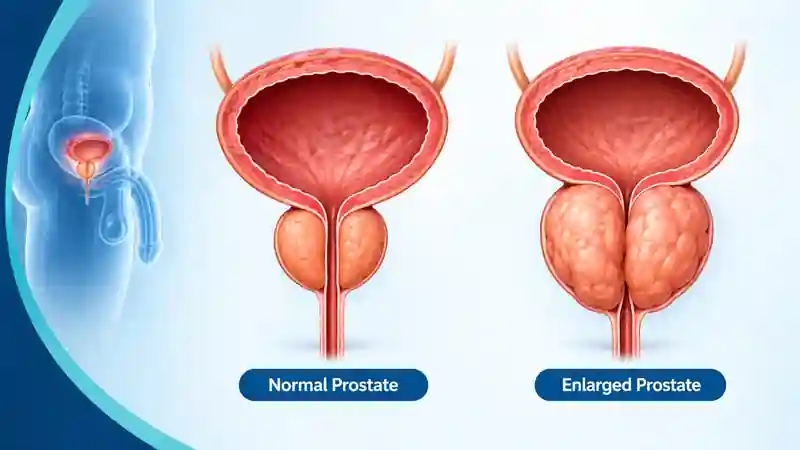
If we say it in simple terms, no single number makes a prostate dangerous. But now the question comes: so what size of prostate is dangerous?
It’s the size where the gland squeezes your urethra hard enough to block urine flow and trigger problems like infections, bladder stones, or even kidney damage. That tipping point is different for every man, and the National Institute of Diabetes and Digestive and Kidney Diseases says symptoms may not be directly related to prostate size. The same agency estimates BPH affects 5% to 6% of men ages 40 to 64 and 29% to 33% of men 65 and older.
To understand this more, stick with us, because the size that changes your treatment options may not be the one you’d guess.
Your prostate is a gland about the size of a walnut. It sits between your bladder and penis, right in front of the rectum, and your urethra runs straight through its centre. Its job is to make the fluid that protects sperm.
But here’s the catch: it keeps growing as you age. In most men, the cause is benign prostatic hyperplasia (BPH), a non-cancerous enlargement, and it’s the most common prostate problem in men over 50.
Nobody knows for sure. The leading theory points to the shifting balance of sex hormones as men age. And here family history matters, so if your father, uncle, or brother dealt with it, you’re more likely to as well.
Geography plays a part too. It’s more common in American and Australian men, and less common in men from China, India, and Japan.
No, it’s not always. Generally, when people ask what size of prostate is dangerous, they expect a magic number. Reality is messier. Your enlarged prostate size matters mainly because of what the extra tissue does to your urine flow.
Picture two men. One has a very large prostate and barely notices. The other has a modestly enlarged one and rushes to the bathroom every hour. The second man needs help sooner, even though his scan looks “better.”
Trouble starts when your bladder can’t empty fully. Leftover urine invites complications, including:
Symptoms rarely show up before age 40, but they become more common with age. Watch for:
One more thing. BPH isn’t cancer, and the National Cancer Institute notes it doesn’t raise your risk of prostate cancer. But the symptoms overlap, and having one doesn’t rule out the other. That’s why testing matters.
Yes, and this is where size really counts. Here’s why the question of what prostate size is dangerous matters for treatment: some procedures only work up to a certain size.
| Treatment | Prostate size it suits | What to know |
|---|---|---|
| TURP (scope through the urethra) | Up to 60 cubic centimetres | Quick symptom relief, but bleeding, infection, a temporary catheter, erectile dysfunction, and incontinence are possible |
| Open prostatectomy | Very large prostates, or when bladder stones or damage are involved | Abdominal incision, a few days in the hospital, higher chance of blood transfusion |
| Laser therapy | Often used when blood thinners rule out other options | Fast relief, but retrograde ejaculation, incontinence, and erectile dysfunction can occur |
| Prostate artery embolization (PAE) | Any size | Local anesthesia, no scars, walking within hours |
Still wondering what size of prostate is dangerous in your case? Don’t guess. Book a consultation with Dr Gaurav Gangwani or call +91 9082394787 to get your prostate checked properly.
The first thing your doctor does is ask you specific questions regarding your symptoms. From there, these tests fill in the picture:
Yes. PAE shrinks the gland by cutting off part of its blood supply, with no cuts into the prostate itself. Dr. Gangwani’s Vascular Clinic describes results comparable to TURP for symptom relief, without general anaesthesia, blood loss, or scars. Most men notice improvement within two to three weeks.
An interventional radiologist numbs the access point and usually threads a thin catheter through the wrist artery. Tiny particles released into the prostate’s arteries slow blood flow to the gland. A few hours later (four to six), you’re walking around, typically without a urinary catheter, and most men return to normal activity by evening. If symptoms ever return, the procedure can be repeated safely.
So, no scary number exists. The real answer to what size of prostate is dangerous depends on your symptoms, how well your bladder empties, and whether complications are creeping in. Size mostly decides which treatment fits, not whether you need help.
If urinary trouble is disrupting your days or nights, Dr Gaurav Gangwani, an interventional radiologist in Mumbai, offers prostate artery embolisation as a non-surgical treatment for an enlarged prostate. Visit him at Dr. Gangwani’s Vascular Clinic, Borivali West, Monday to Saturday, 8:30 am to 8:00 pm, or call +91 9082394787.
There’s no fixed cutoff. Whatever your enlarged prostate size, you don’t have to treat it if it causes no symptoms. Treatment becomes necessary when symptoms disrupt your life or complications appear. Size mainly steers your options. TURP works for prostates up to about 60 cubic centimetres; larger glands may need open surgery, and PAE can be done on any size.
It can be, if you ignore it. Incomplete emptying raises your infection risk and can lead to bladder stones, incontinence, and blood in the urine. A sudden complete inability to urinate is an emergency that needs a doctor right away. In rare cases, bladder and kidney damage follows. Catch it early, and most of this is avoidable.
No. BPH is benign, and it doesn’t increase your cancer risk. The two conditions are separate, though, and a man can have both at once. Because the symptoms look alike, doctors use a PSA test and, when needed, a biopsy to tell them apart.
Most men notice better urinary symptoms within two to three weeks, and the prostate keeps shrinking over the following months. You’ll usually walk around within four to six hours, typically without a urinary catheter, and many men resume normal activities that same day.
Yes. Unlike TURP, which is limited to prostates of about 60 cubic centimetres or less, PAE works on any prostate size. That makes it a useful option when a large gland rules out other procedures. Your doctor will confirm suitability after an ultrasound and a review of your symptoms.
Dr. Gangwani Vascular Clinic, 302/TGN SQUARE 3rd floor Chandawarkar lane Borivali west Mumbai 400092
+91 9326195964
drgauravgangwani@gmail.com
Monday to Saturday: 8.30 am to 8.00 pm. For any quires & assistance please call on: +91 9082394787
Copyright 2026 – www.drgauravgangwani.com
Website Managed by SEO Discovery
WhatsApp us