

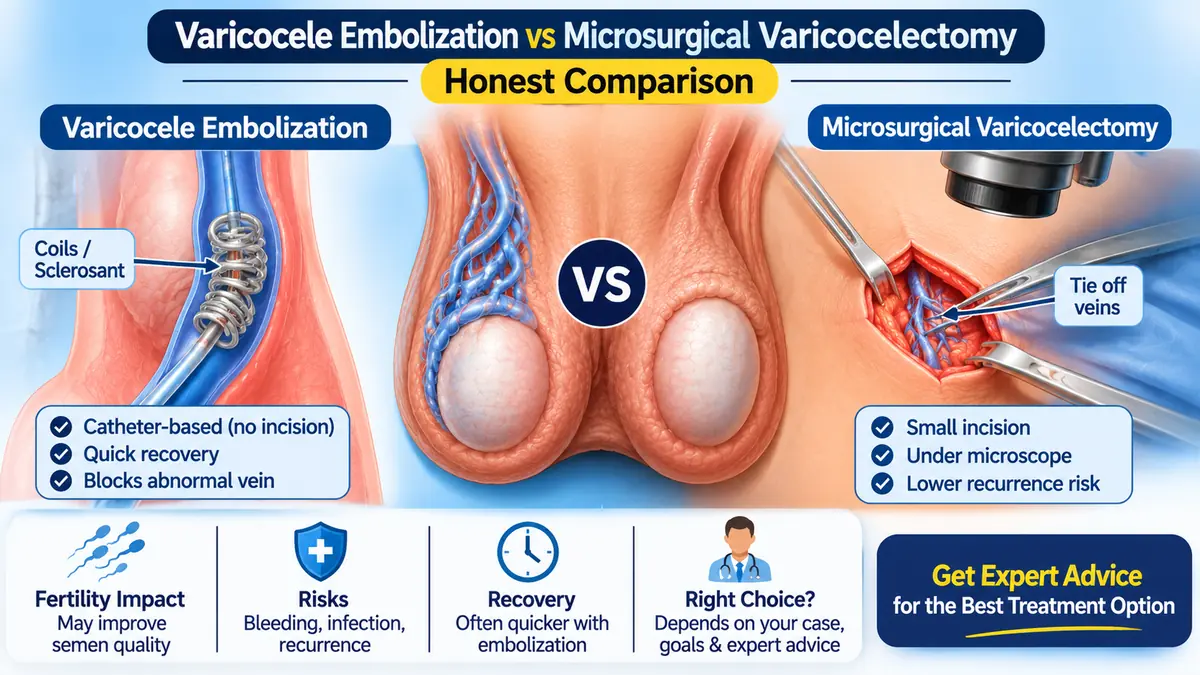
If you have been told you have a varicocele, you may be weighing two quite different ways of treating it. Varicocele embolization blocks the abnormal vein from the inside using a catheter. Microsurgical varicocelectomy ties off the same vein through a small incision, using an operating microscope. Both aim to stop blood flowing backwards through the enlarged veins around the testicle.
The choice matters because varicoceles are linked with male fertility problems. In a large WHO multi-country study of 8,500 couples, a varicocele was found in 25.4% of male partners with abnormal semen parameters, compared with 11.7% of those with normal semen results. That is an association, not proof of cause. Many men with a varicocele have no fertility difficulty at all.
In varicocele embolization, an interventional radiologist passes a thin catheter through a vein, usually in the groin or neck, into the testicular vein. X-ray imaging guides the catheter. The vein is then blocked with coils, a sclerosant (a solution that shrinks and seals the vein) or another embolic agent.
In microsurgical varicocelectomy, a surgeon makes a small incision in the inguinal or subinguinal area, near the groin. Under magnification, the surgeon ties off the affected veins and tries to preserve the testicular artery and the lymphatic vessels that drain fluid from the area.
Neither procedure removes the testicle or acts directly on sperm production. Both correct the abnormal venous drainage that causes the varicocele.
The reason for treatment matters. Some men seek treatment because of infertility and abnormal semen results, while others have persistent pain or discomfort.
For men with infertility and a clinical varicocele (one a doctor can feel), the WHO guideline suggests surgical or radiological treatment over simply waiting. It notes that men with abnormal semen parameters are more likely to benefit. The certainty of that evidence is low, and the trials did not report live births.
On the choice between the two procedures, WHO suggests that either is reasonable, based on very low-certainty evidence. The trials that compared surgery with embolization mostly used older, non-microscopic surgery. Studies directly comparing microsurgery with embolization were lacking. Separately, trials comparing microsurgery with other surgical methods found a small increase in pregnancies and slightly fewer recurrences with microsurgery. That finding does not show microsurgery beats embolization.
Better semen results also do not guarantee a pregnancy or a live birth. Your partner’s fertility factors matter, and the plan may differ if assisted reproduction is being considered.
Embolization is often done under local anaesthesia and commonly allows a quicker return to normal activity. It involves some X-ray exposure and contrast dye. Risks include technical failure, such as being unable to reach or fully block the vein. They also include allergic reaction to contrast, vein injury, clot formation, scrotal pain and persistent or recurrent varicocele.
Surgical recovery involves caring for the incision and a temporary break from strenuous activity. The main risks are bruising or blood collection (haematoma), infection, hydrocele (fluid around the testicle) and rare injury to the testicular artery. In the trials WHO reviewed, hydrocele occurred in roughly 5% to 10% of surgical patients. Those figures were pooled across surgical techniques, not microsurgery alone.
Neither procedure is guaranteed to be pain-free. Individual risk depends on your anatomy and the operator’s experience.
The choice depends on your examination findings, symptoms, previous treatment, fertility goals, anatomy, local expertise and personal preference. Embolization may suit men who prefer a catheter-based approach without an incision, or who have a varicocele that has come back after surgery, provided the veins are suitable.
Microsurgery may be favoured when surgery is chosen and an experienced microsurgeon is available. In that situation, lower recurrence and protecting the surrounding structures weigh heavily.
These are not rigid rules. A varicocele seen only on ultrasound does not automatically need treatment, and a clinical assessment comes first.
Bring specific questions to your specialist:
Ask for both options to be explained, even if the specialist performs only one.
Embolization is a catheter-based radiological treatment. Microsurgical varicocelectomy is a surgical repair performed under magnification. Each has real advantages and limits, and current evidence does not support naming a universal winner.
Dr Gaurav Gangwani is an interventional radiologist whose practice includes embolization, so he performs one of the two procedures discussed here. A good consultation, with him or any specialist, should cover when the other option may suit you better.
Not on current evidence. WHO suggests either may be used, and studies directly comparing microsurgery with embolization are scarce. Which is better depends on your anatomy, goals and available expertise.
This is not settled. Across the trials WHO reviewed, recurrence or persistence ranged from about 3% to 20% across techniques. Microsurgery appears to lower recurrence slightly compared with other surgical methods, but that is not a direct comparison with embolization.
Recovery is often quicker than after surgery, but there is no fixed timeline. Your radiologist will advise when to resume exercise, heavy lifting and sexual activity, based on your procedure and any discomfort at the puncture site.
It may, in selected men, because stopping the abnormal backflow is often followed by better semen parameters. This does not guarantee a pregnancy or live birth.
Yes, though microsurgery is associated with a lower recurrence risk than some other surgical approaches. Follow-up exams and semen analysis help detect it. A recurrence can sometimes be treated with embolization if the anatomy allows.
Dr. Gangwani Vascular Clinic, 302/TGN SQUARE 3rd floor Chandawarkar lane Borivali west Mumbai 400092
+91 9326195964
Monday to Saturday: 8.30 am to 8.00 pm. For any quires & assistance please call on: +91 9082394787
Copyright 2026 – www.drgauravgangwani.com
Website Managed by SEO Discovery
WhatsApp us