

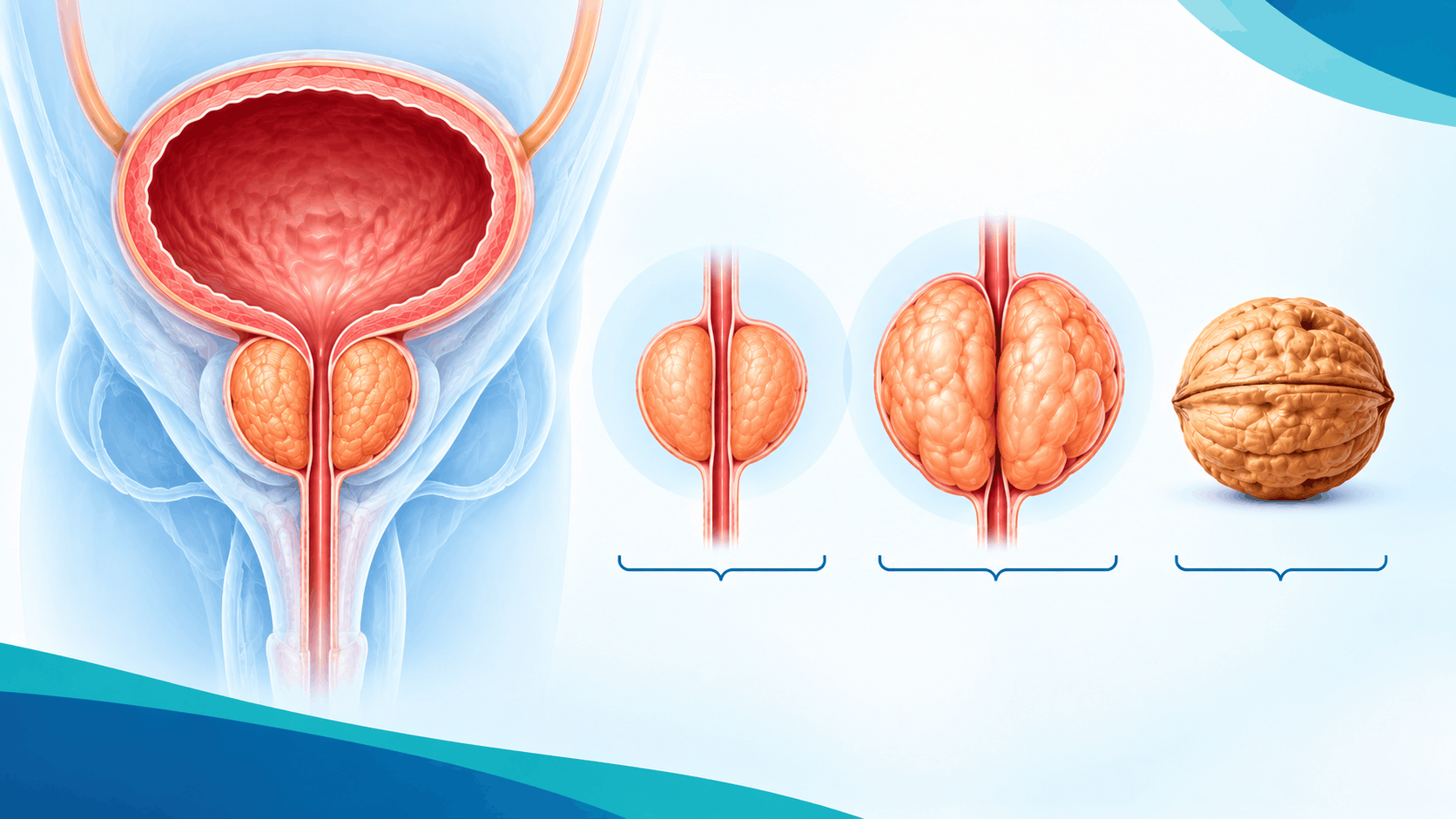
A healthy adult prostate measures about 20 to 30 cc, roughly the size of a walnut. That’s the quick answer on prostate normal size in cc, but the number only tells half the story. Plenty of men sit above 30 cc and feel fine, while others struggle with a smaller gland. And it matters for a lot of men : US population-based studies found that 56% of men between 50 and 79 reported BPH symptoms. Keep reading, and you’ll see where your own number fits and what to do about it.
Your urethra passes directly through the center of your prostate, which is located between your bladder and penis. It makes the fluid that protects sperm. Doctors expect a healthy adult volume of 20 to 30 cc. In a transrectal ultrasound study of 175 healthy men, the median was about 23 ml in men without prostate adenoma and 28 ml in those with early signs of it. Because the urethra passes through the middle, extra growth squeezes it, and that’s why size changes how you urinate.
One cc is one cubic centimetre, which equals one millilitre (ml). So 25 cc and 25 ml describe the same volume. Your ultrasound report may use either one.
An ultrasound captures three measurements: length, width and height. Your doctor multiplies them, then multiplies the result by 0.52, because the prostate is shaped like an oval rather than a box. A transrectal ultrasound gives the clearest picture. It also shows the gland’s shape, which helps when planning treatment.
Your prostate doesn’t stay at 25 cc forever. It grows slowly, and knowing the typical prostate volume by age helps you read your own report. Knowing the prostate normal size in cc for a 25-year-old won’t help much at 60, though. A German community study of men aged 50 to 80 (Berges and Oelke, World Journal of Urology, 2011) found the average volume climbing from 24 cc to 38 cc across those decades. Those men were German, so numbers can differ a little for Indian men.
| Measure | Volume | What it means |
| Healthy adult | 20–30 cc | Typical walnut-sized gland |
| Average at age 50 (study) | About 24 cc | Still within the normal range |
| Average at age 80 (study) | About 38 cc | Mild growth is very common by now |
| Above 30 cc | 30+ cc | A common dividing line researchers use for enlargement |
| Up to 60 cc | Up to 60 cc | The size range where TURP surgery is possible |
Notice that the average man crosses 30 cc somewhere along the way. That’s why enlargement counts as a normal part of ageing for most men. BPH shows up in about four out of five men.
No. Enlarged prostate size doesn’t match symptoms neatly. A review on whether prostate size matters found no convincing reports linking symptoms or flow rate to gland size. However, a bigger starting volume does raise the odds of progression, urinary retention and eventual surgery. So the prostate’s normal size in cc works as a guide, not a verdict.
Picture a 58-year-old man with a 45 cc prostate who sleeps through the night and has a strong stream. Now picture another man with a 35 cc gland who gets up three times nightly and strains to urinate. (These are illustrative examples, not real patients.) The second man needs attention sooner, even though his gland is smaller. Symptoms matter more than the number alone.
Here’s how the timeline looks. BPH rarely causes symptoms before age 40. By 55, one in four men reports symptoms, and by 75, half do of the men who develop BPH, about two in five end up needing treatment.
See one if symptoms disturb your sleep or daily routine. Don’t wait if you get repeated urinary infections, blood in your urine or bladder stones, because a full bladder raises those risks. A sudden, complete inability to urinate is an emergency, so go immediately. Also remember that BPH isn’t cancer, but the two can exist together. Your doctor can rule out cancer with a PSA test and an exam.
Not sure where your prostate stands? Get your volume measured and your symptoms reviewed by Dr Gaurav Gangwani. Call +91 9082394787 or book your appointment online.
Going past the prostate’s normal size in cc doesn’t automatically mean you need a procedure. With no symptoms, you may need nothing at all. When symptoms do interfere, surgeries like TURP work only up to about 60 cc and can cause bleeding or require a temporary catheter, while larger glands may need open surgery. Prostate artery embolisation (PAE) offers a non-surgical alternative, and it works on any enlarged prostate size.
You get local anaesthesia, and Dr Gangwani usually enters through the artery in your wrist. He guides a tiny catheter to the arteries feeding the prostate and blocks them with small particles, so the gland slowly shrinks. Most patients walk around within four to six hours without a urinary catheter, and symptoms start improving in two to three weeks.
Now that you know the normal prostate size in cc, the smartest move is learning your own number. At Dr Gangwani’s Vascular Clinic in Borivali West, Mumbai, Dr Gaurav Gangwani, an interventional radiologist with 10+ years of experience, reviews your symptoms, orders the right tests and explains every option honestly, including the ones that don’t involve a procedure. Call +91 9082394787 or book online. We’re available Monday to Saturday, 8:30 am to 8:00 pm. You can also read about our non-surgical treatment of enlarged prostate.
Yes, by the usual 30 cc dividing line, a 40 cc gland counts as enlarged. But the label alone doesn’t tell you what to do. Doctors also judge the result against typical prostate volume by age, since a 40 cc gland is more expected at 70 than at 35. They then look at your symptoms, your urine flow and how much urine stays in your bladder. A man with a 40 cc prostate and no complaints usually needs only monitoring.
No single number decides it. Doctors recommend treatment because of symptoms and complications, such as urinary retention, repeated infections, bladder stones or kidney strain. Size does steer the type of procedure, though. TURP suits glands up to about 60 cc; larger glands may need open surgery, and PAE works at any size.
Natural growth rarely reverses on its own. PAE shrinks the gland by cutting off part of its blood supply. Symptoms usually improve within two to three weeks, and the prostate keeps shrinking over a few months. We can’t promise a specific final number, but relief of symptoms is the real goal.
A digital rectal exam gives a rough sense of size. A transrectal ultrasound gives exact measurements and shows the gland’s anatomy. An ultrasound can also measure leftover urine in your bladder after you urinate, which shows how much the prostate blocks your flow.
Not necessarily. An enlarged prostate can raise PSA, but so can prostate cancer, recent surgery, recent tests and prostatitis (an infection). Your doctor reads PSA together with your exam, symptoms and ultrasound rather than on its own.
Dr. Gangwani Vascular Clinic, 302/TGN SQUARE 3rd floor Chandawarkar lane Borivali west Mumbai 400092
+91 9326195964
drgauravgangwani@gmail.com
Monday to Saturday: 8.30 am to 8.00 pm. For any quires & assistance please call on: +91 9082394787
Copyright 2026 – www.drgauravgangwani.com
Website Managed by SEO Discovery
WhatsApp us