

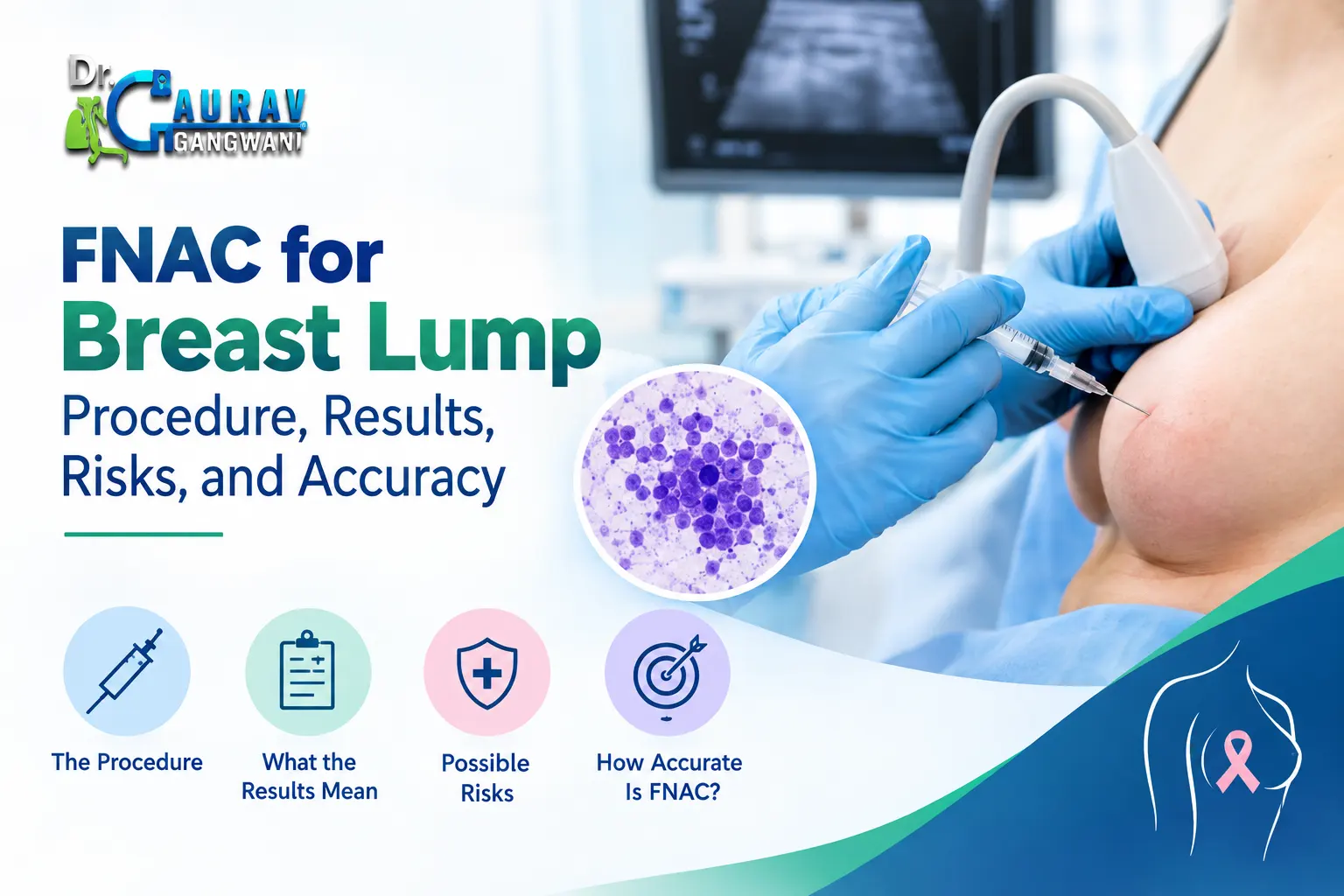
A breast lump can come from many causes. Most are benign cysts, fibroadenomas, infections but the only way to know is to have them checked.
FNAC breast lump, or fine needle aspiration cytology, uses a thin needle to draw a small sample of cells from the lump for a pathologist to examine. A 2026 review of 15 studies backed it up as a quick, low-cost first step, especially where resources are limited, but flagged that results depend a lot on sample quality and the skill of whoever performs it.
FNAC findings are read alongside your examination and imaging, never alone. See a doctor if you notice a new or changing lump. Deep or hard-to-feel lumps are usually sampled under ultrasound guidance for accuracy; the kind of image-guided FNAC and biopsy work Dr. Gaurav Gangwani, an interventional radiologist in Mumbai, carries out.
The process starts with a careful look at the lump itself, along with any breast imaging already on record. This helps the doctor judge whether FNAC is the right approach and pinpoint exactly where the needle should be placed. National Health Mission guidelines are clear on this point: imaging should come first, ahead of FNAC or a core needle biopsy, whenever a breast issue is being looked into.
Once that’s done, the skin over the lump is cleaned, and a fine needle attached to a syringe goes into the area. It only takes a moment to draw out a small amount of cellular material. If the lump is hard to feel or needs more precise placement, ultrasound often guides the needle in.
From there, the sample is transferred onto slides or into a container and sent off to the lab. A pathologist studies the cells closely and puts together a report based on what’s found.
The sampling itself is usually brief. You may feel a short needle prick, pressure, or mild discomfort while the sample is collected.
The fnac breast lump report is based on how the collected cells appear under the microscope. Findings generally fall into a few categories: benign, suspicious or malignant, inflammatory, or inadequate for proper interpretation.
A benign result means that no malignant cells were identified in the sample examined from what was collected. That said, it’s never looked at by itself; it has to match up with the physical exam and the imaging already on file.
If the findings are suspicious or malignant, the next step is usually more testing and a treatment plan built around it. What follows is guided by the complete clinical picture and not decided from the FNAC result in isolation.
Sometimes the sample simply doesn’t contain enough material to draw a firm conclusion. This is called an inadequate or non-diagnostic result. It does not indicate, one way or the other, whether the lump is cancerous. In this situation, the doctor may repeat the sampling or choose a different biopsy method.
There are very few side effects; however, some side effects may occur for a brief period of time.
Infection is uncommon, but persistent or worsening redness, swelling, pain, or discharge should be reported to a doctor.
Another practical limitation is an inadequate sample. If the cells collected do not adequately represent the lesion, the procedure may need to be repeated or followed by another type of biopsy.
There’s no fixed accuracy number that holds true for every fnac breast lump. It comes down to a mix of things: what kind of lesion is involved, whether enough representative cells were actually captured, how the sample was taken, and the skill involved in reading it afterwards.
One 2026 systematic review found solid diagnostic performance where standardized reporting systems were in use, though it also flagged lower specimen adequacy in certain cystic and radiologically occult lesions. That gap is a good reminder that results from one study shouldn’t be stretched into a blanket accuracy rate for every patient walking through the door.
Indian researchers have kept working on this too, particularly around standardized reporting for breast FNAC. A 2026 meta-analysis focused on women aged 40 and under found that diagnostic performance wasn’t consistent across categories, with inadequate samples and harder-to-read lesions coming up again and again as limiting factors.”
Given all this, FNAC results tend to carry the most weight when read together with the clinical exam and imaging, not as a standalone verdict. When a larger tissue sample becomes necessary, a core needle biopsy can offer something FNAC can’t it pulls an actual piece of tissue rather than loose cells. Any decision on further testing rests with the treating doctor, based on the full clinical picture rather than one result alone.
FNAC can be a useful way to examine cells from a breast lump without removing a larger piece of tissue. Understanding how the procedure is performed, what different results can mean, its possible risks, and why accuracy varies can help to discuss the next step with the doctor. If the FNAC result doesn’t line up with the clinical findings or imaging, further evaluation is usually the next step.
For cases that require precise, image-guided FNAC or biopsy, Dr. Gangwani’s Vascular Clinic provides specialized interventional radiology care in Mumbai. With a focus on accurate, image-guided procedures, the clinic helps patients take the next step toward a clearer diagnosis with confidence.
People will feel a sting from the injection and some pain during the process. Occasionally, bruising may occur after the procedure as well.
Getting the sample only takes a few minutes. The whole visit, though, can stretch longer once you add in the exam, setup, and imaging guidance if that’s used.
Basically, not enough usable cells made it into the sample to give a reliable reading. That alone means nothing to do with cancer
Not really. FNAC pulls out individual cells to study, while core biopsy takes actual tissue pieces for a deeper look.
It can; malignant cells show up if the sample’s good and they’re present. But the result still gets weighed against the exam and imaging, and some cases end up needing a tissue biopsy anyway.
Dr. Gangwani Vascular Clinic, 302/TGN SQUARE 3rd floor Chandawarkar lane Borivali west Mumbai 400092
+91 9326195964
drgauravgangwani@gmail.com
Monday to Saturday: 8.30 am to 8.00 pm. For any quires & assistance please call on: +91 9082394787
Copyright 2026 – www.drgauravgangwani.com
Website Managed by SEO Discovery
WhatsApp us