
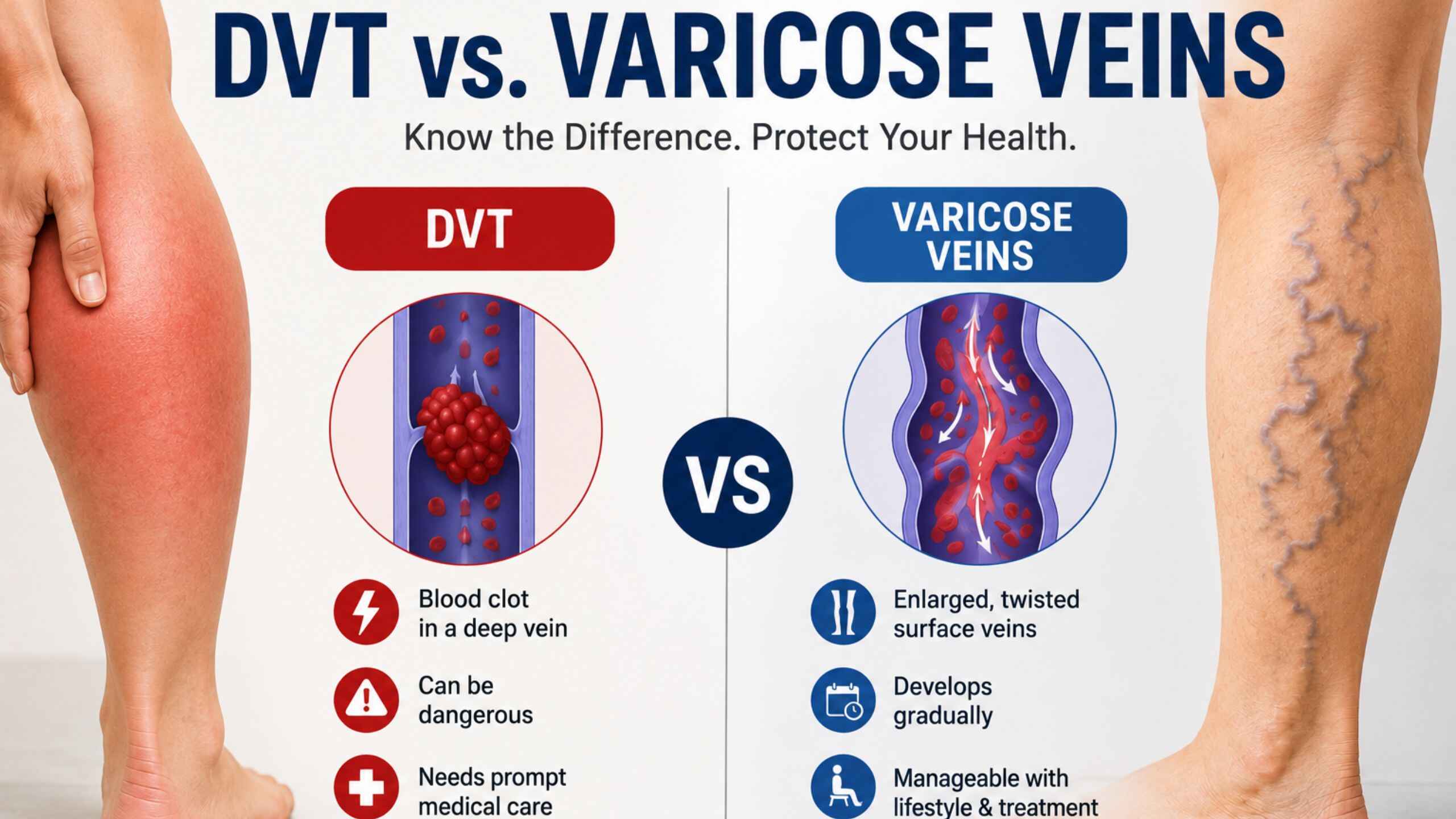
Deep vein thrombosis (DVT) is a blood clot that forms in a deep vein, usually in the leg. Varicose veins are enlarged, twisted veins that develop when blood does not flow properly through the veins.
Although both can cause leg discomfort or swelling, they are different conditions. DVT can become dangerous if the clot travels to the lungs, while varicose veins usually develop slowly because of weak or damaged vein valves.
The easiest way to understand the difference is to look at what is happening inside the vein.
| Deep Vein Thrombosis | Varicose Veins |
| A blood clot forms in a deep vein | Veins become enlarged and twisted |
| Usually affects a deep vein in the leg | Usually affects veins close to the skin |
| Symptoms may appear suddenly | Usually develops gradually |
| May cause one-sided swelling and pain | May cause aching, heaviness, or itching |
| Can lead to a pulmonary embolism | Can cause skin changes, ulcers, or bleeding in some cases |
| Requires prompt medical assessment | Treatment depends on symptoms and severity |
The conditions may look similar at first, but they have different causes and require different approaches to treatment.
Think of DVT as a clotting problem inside a deeper vein.
A blood clot can partially or completely block blood flow through the vein. DVT most often develops in the lower leg, thigh, or pelvis.
The important concern is that part of the clot can sometimes break away and travel through the bloodstream to the lungs. This can cause a pulmonary embolism, which can be life-threatening.
DVT symptoms can include:
However, DVT does not always cause obvious symptoms. This makes it important to take sudden or unexplained leg changes seriously.
Varicose veins are more of a vein-valve and blood-flow problem.
Healthy veins contain small one-way valves that help move blood back toward the heart. When these valves or the vein walls become weak or damaged, some blood can flow backward and collect in the vein.
Over time, the vein can become enlarged, twisted, and more visible under the skin.
This may lead to:
Symptoms often become worse after sitting or standing for long periods and may improve when the legs are raised or when you lie down.
The causes are quite different.
DVT is more likely when blood flow becomes slower, or the blood has a greater tendency to clot.
Risk can increase with:
Having several risk factors can increase the likelihood of developing a clot.
Varicose veins are often linked to increased pressure in the leg veins and weak or damaged valves.
Factors that may contribute include:
These factors can make it harder for blood to return efficiently toward the heart.
Sometimes the pattern gives you a clue, but symptoms alone cannot confirm the diagnosis.
For example, varicose veins are usually visible. You may notice raised, twisted veins that have been present for some time.
DVT may be less obvious. You might suddenly notice swelling, warmth, tenderness, or pain in one leg without seeing a large vein on the surface.
Long-standing visible veins + gradual discomfort may fit with varicose veins.
New one-sided swelling + sudden pain or tenderness needs prompt medical evaluation for possible DVT.
That does not mean every swollen leg has a blood clot. Other conditions can cause similar symptoms, so proper testing is important.
Not directly.
Varicose veins and DVT are separate conditions. Having varicose veins does not mean that you have a deep vein clot.
However, a person who already has varicose veins can still develop DVT. Therefore, new symptoms should not automatically be blamed on existing varicose veins.
If your usual symptoms suddenly change, especially with one-sided swelling or pain, contact a healthcare professional.
There is no reliable way to diagnose DVT simply by looking at your leg.
A healthcare professional may ask about your symptoms, recent travel, surgery, medical history, medicines, and other risk factors.
For suspected DVT, testing may include blood tests and imaging. Duplex ultrasound is commonly used to examine blood flow and look for a clot.
Varicose veins can often be identified during an examination. A duplex ultrasound may also be used to see how blood is moving through the veins and whether the valves are working properly.
The goal is to find the actual cause rather than treating every type of leg swelling in the same way.
Treatment depends on the condition and the person’s individual situation.
DVT is commonly treated with anticoagulant medicines, also called blood thinners. These medicines help prevent the existing clot from becoming larger and reduce the chance of new clots forming.
Some severe cases may require other treatments or procedures.
Because of the potential risk of pulmonary embolism, suspected DVT should not be ignored or treated only with home remedies.
Treatment for varicose veins depends on how severe the symptoms are.
Lifestyle measures may help with discomfort, including:
A healthcare professional may also recommend compression therapy or procedures such as sclerotherapy or endovenous ablation when appropriate.
Some vein symptoms can wait for a scheduled evaluation. Others should be checked quickly.
Seek prompt medical attention if you develop:
If possible DVT symptoms occur along with sudden shortness of breath, chest pain, coughing up blood, fainting, or severe breathing difficulty, seek emergency medical care immediately.
These can be signs of a pulmonary embolism.
If you have visible varicose veins, recurring leg heaviness, swelling, or discomfort, do not simply assume the symptoms are normal.
Keep track of:
This information can help your healthcare provider understand what may be happening.
For persistent or concerning vein symptoms, Dr. Gangwani’s Vascular Clinic can provide appropriate evaluation and help determine whether further testing or treatment is needed.
DVT and varicose veins can both affect the legs, but they are not interchangeable conditions.
DVT involves a blood clot in a deep vein and can become dangerous if the clot travels to the lungs. Varicose veins involve enlarged surface veins, usually because of problems with the valves that control blood flow.
The most important thing is not to diagnose yourself based only on how your leg looks. A sudden change in swelling, pain, warmth, or skin color deserves medical attention.
No. DVT is a blood clot in a deep vein, while varicose veins are enlarged, twisted veins caused by problems with normal blood flow through the veins.
DVT is generally more urgent because a clot can travel to the lungs and cause a pulmonary embolism. Varicose veins are usually less dangerous but can cause ongoing symptoms and complications in some people.
Yes. Varicose veins can cause swelling in the legs or ankles, especially after sitting or standing for long periods.
Yes. DVT is a problem in a deep vein, so there may be no obvious vein visible on the skin. Some people may also have few or no symptoms.
Consider an evaluation if you have persistent leg swelling, aching, heaviness, visible varicose veins, skin changes, or symptoms that interfere with daily activities. If symptoms suddenly suggest a possible blood clot, seek prompt medical care rather than waiting for a routine appointment.
Dr. Gangwani Vascular Clinic, 302/TGN SQUARE 3rd floor Chandawarkar lane Borivali west Mumbai 400092
+91 9326195964
drgauravgangwani@gmail.com
Monday to Saturday: 8.30 am to 8.00 pm. For any quires & assistance please call on: +91 9082394787
Copyright 2026 – www.drgauravgangwani.com
Website Managed by SEO Discovery
WhatsApp us