

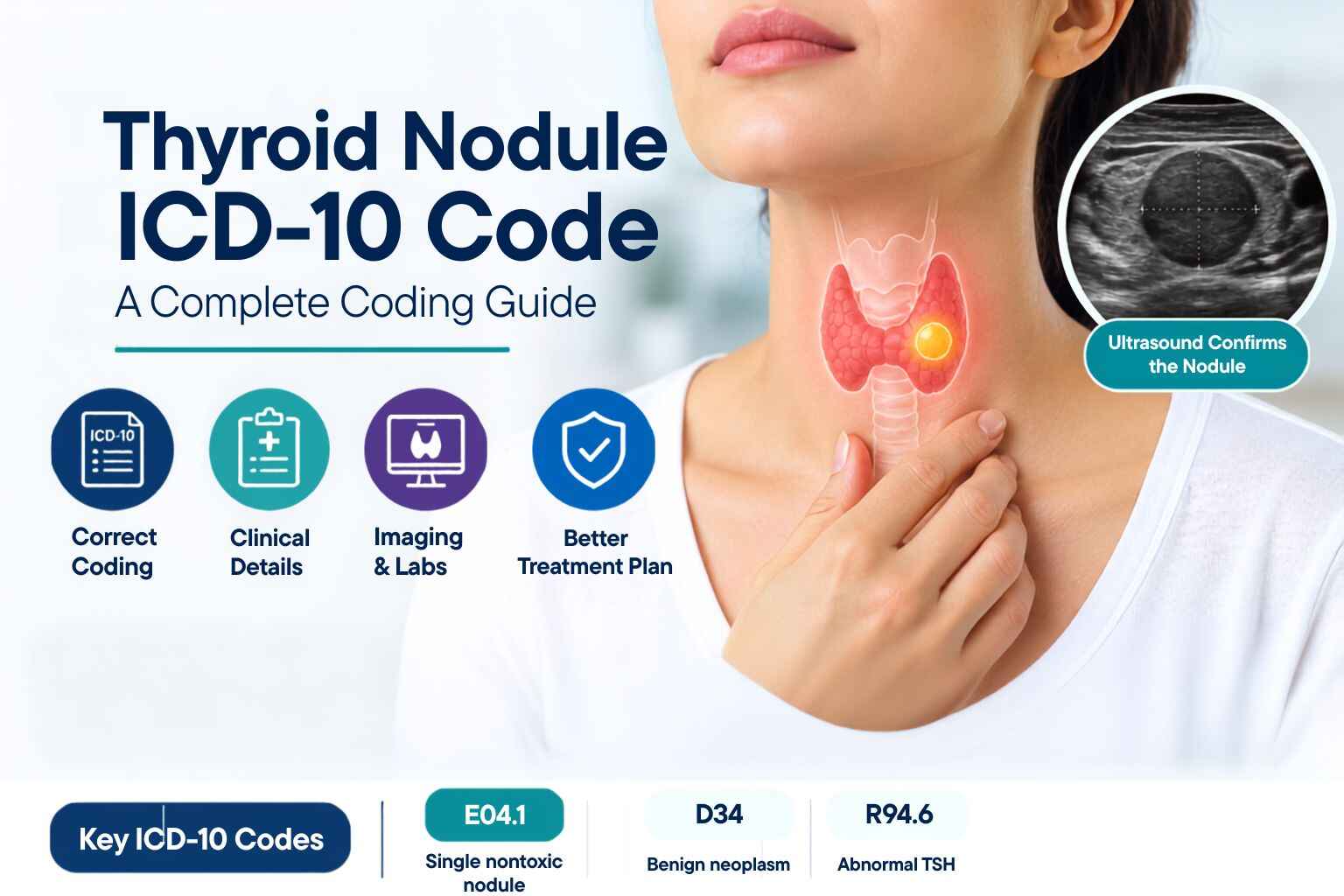
This guide walks through the thyroid nodule ICD-10 code system, why it matters, and how the right code actually gets picked once a nodule is confirmed. Studies suggest that as many as half of people will develop a thyroid nodule by the time they’re 60, and most turn out to be nothing serious. We see this play out a lot at our clinic, which is why getting the coding right after an ultrasound-confirmed thyroid nodule matters just as much for treatment planning as it does for the paperwork side of things.
The thyroid nodule ICD-10 code lives in Chapter 4 of ICD-10-CM, somewhere in the E00 to E07 range set aside for thyroid disorders. Most of the time, you’ll see E04.1 used, which covers a single nontoxic nodule, sometimes written up as a colloid nodule or nontoxic uninodular goiter. It’s billable as it stands, so it doesn’t need anything else tacked on to go through on a claim.
This isn’t just paperwork for the sake of it. Get the code wrong and you can end up with a rejected claim, a repeat scan nobody needed, or confusion further down the line if a patient bounces between an endocrinologist, a radiologist and someone offering non-surgical thyroid treatment.
Not every nodule gets coded the same way, and the choice usually comes down to a handful of clinical details.
E04.1: a single, nontoxic thyroid nodule, by far the one you’ll see most.
E04.2: nontoxic multinodular goiter, for when there’s more than one nodule.
E04.9: other nontoxic goiter, unspecified, for cases that don’t fit neatly into diffuse or nodular.
E05.10: thyrotoxicosis with a toxic single nodule, when the nodule is pumping out excess hormone.
D34: benign neoplasm of the thyroid, for confirmed benign growths like adenomas.
R94.6: abnormal thyroid function study results, occasionally used before a firm diagnosis lands.
A Quick Note on Documentation
None of these should be assigned off a physical exam alone. You need the ultrasound findings, the TSH and T3/T4 numbers, and where it’s relevant, a biopsy result, before any of this makes sense on paper.
It usually plays out in roughly this order:
If you’re not sure which of these stages you’re at, it’s worth just speaking with our team rather than assuming.
Once the code’s assigned, what happens next depends on whether it’s benign, toxic, or flagged as suspicious. Most nontoxic nodules just get watched with repeat ultrasounds every so often. Others, especially ones causing visible swelling or discomfort, might be a candidate for minimally invasive treatment like radiofrequency or microwave ablation, which sidesteps surgery entirely in a lot of cases. Dr. Gangwani has treated a fair number of patients this way, and a consultation before jumping to surgery is usually worth it.
Using E04.1 when there’s actually more than one nodule (that’s E04.2’s job).
Marking a toxic nodule as nontoxic because nobody checked the thyroid function tests.
Skipping laterality or nodule count in the notes.
Assigning a code straight off imaging without confirming hormone status first.
Forgetting to update the code once a follow-up biopsy changes the picture.
A brief aside
Even people who do this for a living mix up E04.1 and D34 sometimes, since both can describe a single thyroid growth. The real difference is whether pathology calls it a nodule or something that meets the bar for a defined neoplasm.
None of this is complicated once the clinical picture is actually clear, but it does rest on proper imaging, hormone testing, and a biopsy where one’s needed. If you’ve recently been told you have a thyroid nodule and aren’t sure what comes next, book an appointment at Dr. Gangwani’s Vascular Clinic and we can talk through whether monitoring or a non-surgical procedure makes more sense for you.
1. What is the correct thyroid nodule ICD-10 code for a single benign nodule?
That’s E04.1, used once a single nontoxic nodule is confirmed on imaging.
2. Is a thyroid nodule always coded the same way?
No. It depends on whether there’s one nodule or several, whether it’s producing extra hormone, and whether malignancy’s been ruled out.
3. Can a thyroid nodule be cancerous?
Most aren’t, but a small share are, which is exactly why biopsy results matter for the diagnosis and the coding both.
4. Does every thyroid nodule need treatment?
Not always. Plenty of nontoxic ones just get monitored, while others causing symptoms might be treated with non-surgical options.
5. Where can I get my thyroid nodule assessed properly?
Our clinic does ultrasound-guided assessment and offers non-surgical treatment for confirmed nodules.
Dr. Gangwani Vascular Clinic, 302/TGN SQUARE 3rd floor Chandawarkar lane Borivali west Mumbai 400092
+91 9326195964
drgauravgangwani@gmail.com
Monday to Saturday: 8.30 am to 8.00 pm. For any quires & assistance please call on: +91 9082394787
Copyright 2026 – www.drgauravgangwani.com
Website Managed by SEO Discovery
WhatsApp us