
For millions of working professionals, the end of the workday brings a familiar, yet unwelcome, guest: a dull, throbbing ache in the legs. You may dismiss it as just tiredness due to prolonged standing or desk work. However, when that heavy, tired feeling develops into the main character of your day, your body may be warning that it is time to get something more significant checked out.
If you find yourself rubbing your calves every evening or desperately propping your feet up on a pillow, it is time to ask the critical question: Could this be varicose veins?
At Dr. Gaurav Gangwani’s clinic, the focus is on understanding these signals before they turn into more serious circulatory issues.
To understand why your legs hurt specifically after work, we need to look at how blood travels against gravity back to your heart. Your arteries carry oxygen-rich blood down to your feet. Your veins have a harder job: pushing that blood back up to the chest. They rely on one-way valves and the contraction of your calf muscles (known as the “second heart”).
When you are stationary whether standing on a shop floor or sitting in an office chair those calf muscles aren’t pumping effectively. Blood begins to pool in the lower legs. Over time, this pressure weakens the vein walls and damages the valves. When those valves fail, blood flows backward and collects, causing veins to stretch, twist, and bulge.
This is why the pain intensifies in the evening. Gravity has been working against you all day. While lying flat at night relieves the pressure, the daily cycle of pooling blood eventually leads to chronic venous insufficiency, often visible as varicose veins.
Many people assume varicose veins are only a cosmetic issue—those twisted, blue ropes visible just under the skin. However, the aching sensation usually starts before the veins become highly visible. Specialists like those at Dr. Gangwani’s Vascular Clinic look for a cluster of symptoms, including:
If your leg ache is accompanied by skin discoloration (darkening around the ankles) or dry, hardened skin, the condition may be progressing beyond simple discomfort.
For mild cases, lifestyle changes can help. Compression stockings (worn during the day) provide external support to collapsed veins, helping push blood upward. Elevating your legs for 15 minutes in the evening and staying hydrated also reduces viscosity.
However, if your quality of life is suffering if you are avoiding social activities because your legs hurt, or if the pain disrupts your sleep it is time to seek a medical opinion. The good news is that modern treatment has moved far beyond the painful “vein stripping” surgeries of the past. Today, interventional radiology offers non-surgical solutions that target the root cause of the leaky veins without cutting or general anesthesia. Dr. Gaurav Gangwani specializes in these advanced, pinhole treatments that allow patients to walk out of the clinic pain-free the same day.
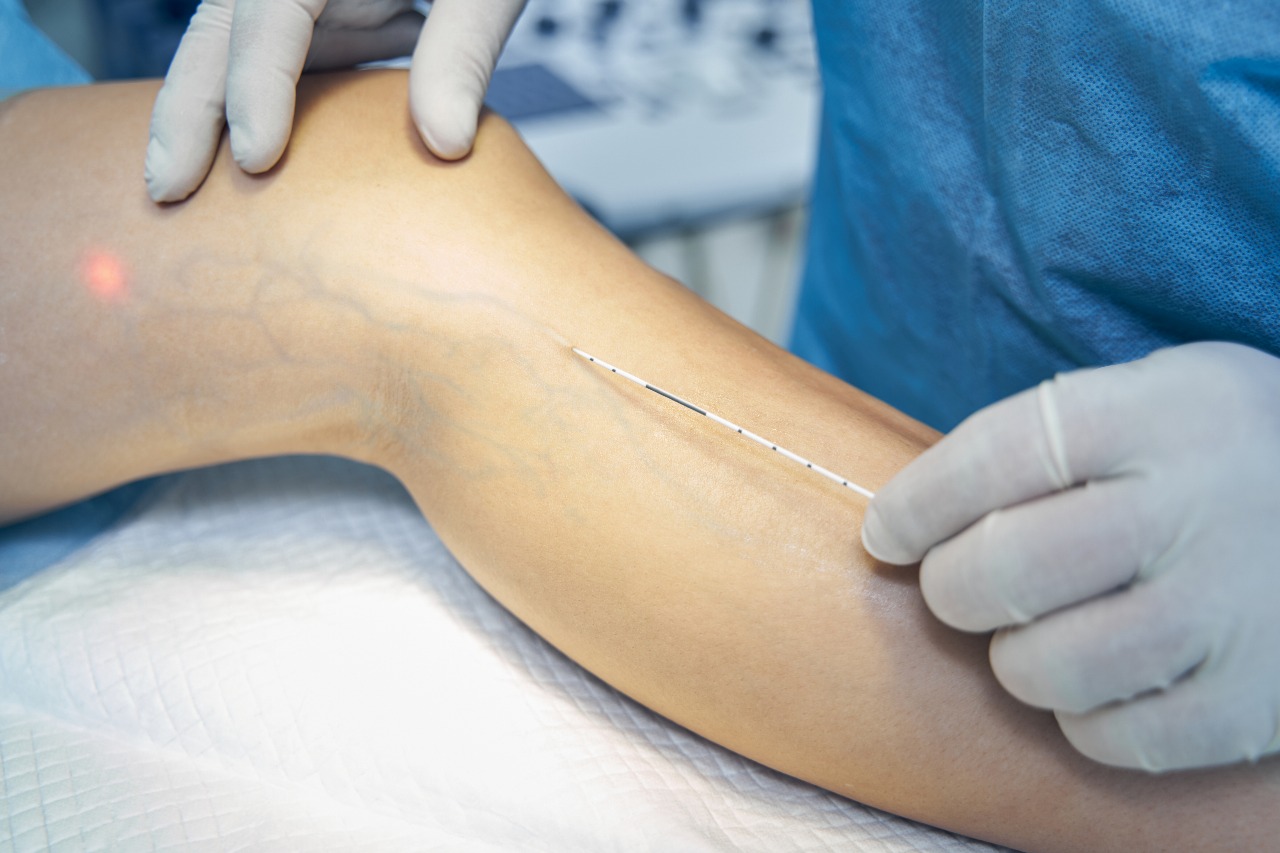
If you are diagnosed with venous insufficiency, you do not need to fear surgery. The best and most effective modern treatment nowadays is Endovenous Laser Ablation (EVLA) or Radiofrequency Ablation (RFA). Below is its working process:
Because the procedure requires no incision, there is no scarring, no hospital stay, and minimal downtime. Most patients return to work the very next day—a far cry from the weeks of recovery required by old-fashioned surgery.
Your evening leg aches are not “just in your head,” nor are they a normal price to pay for having a job. They are a physiological sign of pressure and pooling blood that deserves attention. Ignoring the ache can lead to skin changes, ulcers, and more severe venous disease.
Fortunately, you do not have to live with the pain or fear invasive surgery. With modern, non-surgical advancements, relief is faster and safer than ever before. If you are ready to stop dreading the end of your workday and start enjoying pain-free evenings, consult with a specialist. Dr. Gangwani’s Vascular Clinic offers the expertise required to diagnose the root cause and restore the health of your legs without the stress of a scalpel. Listen to your legs they are telling you it is time for a solution.
Ques1. Can sitting at a desk all day cause varicose veins, or is it only standing?
Ans: Well, exposure to either sitting or standing positions for a long time can develop varicose veins. Sitting for longer than 8 hours hardly makes the blood flow in the legs, whereas standing continuously increases the pressure on the vein valves. Taking a 5 minute walking break every hour is essential to activate calf muscles and keep blood moving.
Ques2. Are compression stockings really necessary, and how do they work?
Ans: Yes, they are often the most effective conservative treatment. They provide graduated pressure (tightest at the ankle, looser at the thigh) that physically prevents blood from pooling in the lower legs, reducing pain and stopping the progression of vein damage.
Ques3. Will my varicose veins come back after non-surgical laser treatment?
Ans: The treated vein itself closes permanently and cannot return. However, because venous insufficiency is often genetic, new incompetent veins may develop in different locations over time. These can be treated non-surgically just as easily if they appear.
Ques4. How soon can I return to work after a minimally invasive vein procedure?
Ans: Most patients return to desk jobs the very next day. Walking is encouraged immediately after the procedure, while heavy lifting and high-impact exercise should be avoided for about 5 to 7 days to ensure proper healing.
Ques5. Is the procedure painful, and what kind of anesthesia is used?
Ans: The procedure is performed under local anesthesia, so you remain awake but feel no pain. Most patients report only mild discomfort during the injection of the anesthetic, and the laser or radiofrequency ablation itself is virtually painless.
Dr. Gangwani Vascular Clinic, 302/TGN SQUARE 3rd floor Chandawarkar lane Borivali west Mumbai 400092
+91 9326195964
drgauravgangwani@gmail.com
Monday to Saturday: 8.30 am to 8.00 pm. For any quires & assistance please call on: +91 9082394787
Copyright 2026 – www.drgauravgangwani.com
Website Managed by SEO Discovery
WhatsApp us