

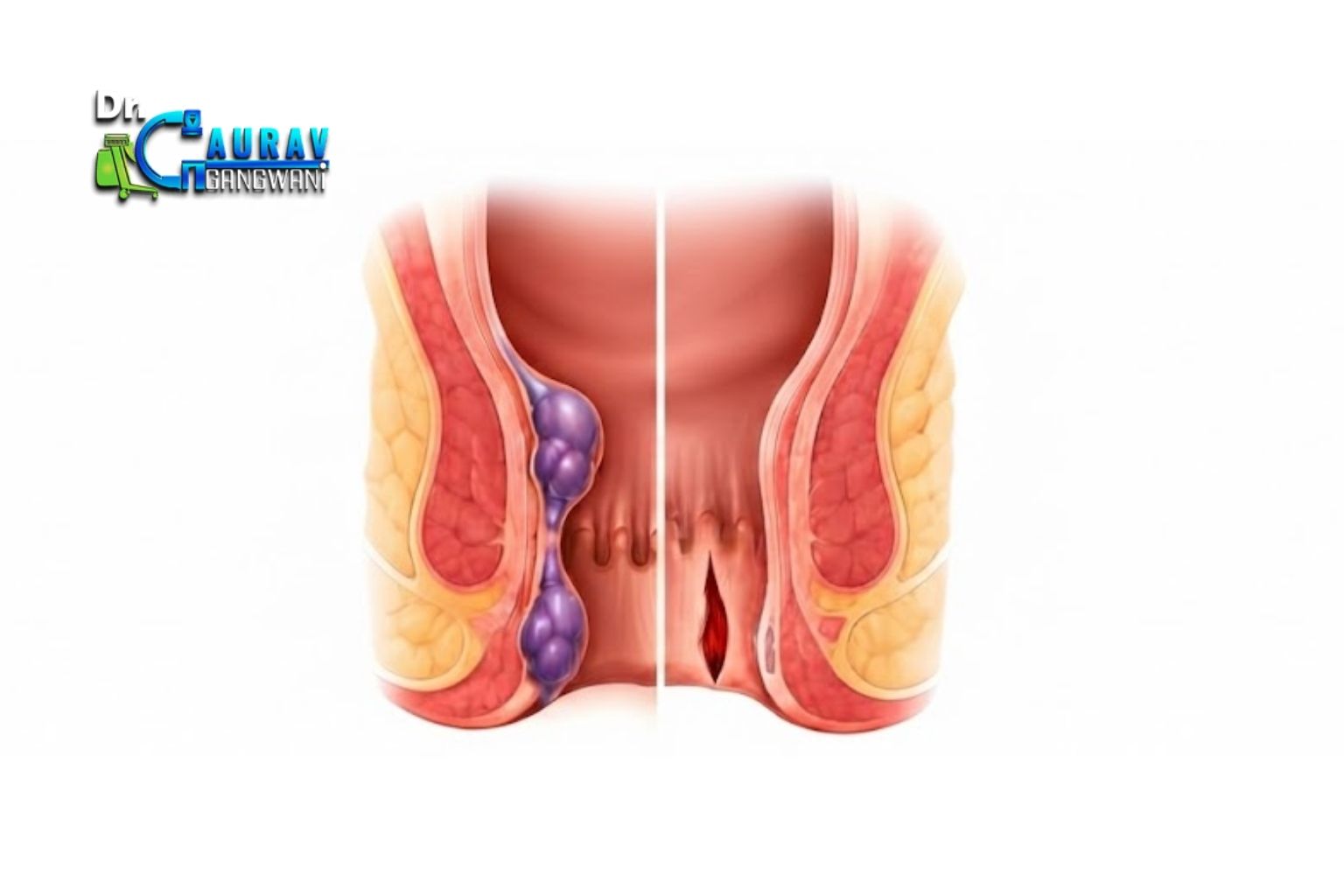
Blood after a bowel movement is scary, and most people blame piles straight away. But that’s not always the case. A 2026 Hindustan Times article highlights that rectal bleeding can have more than one cause. Piles and fissures can both cause bleeding, which is why people often confuse them. Pain is usually the giveaway, since fissures tend to cause a sharp or burning pain. If you’re unsure what’s behind the bleeding, it’s worth getting checked.
For non-surgical treatment of piles and fissures, consult Dr. Gangwani’s Vascular Clinic in Mumbai.
Hemorrhoids, or piles, are swollen veins in and around the anus. Some sit inside, others outside. The inside kind often bleeds and may bleed or prolapse during straining. The outside kind may feel like a small lump or just ache. If a clot forms in one, the pain can hit fast.
An anal fissure is a tiny split in the lining of the anus. Passing hard or large stools and constipation are common causes, though long-term diarrhea or other irritation can play a part too. The pain is often sharp or burning while you go, and it can linger for a while afterward. You might also spot bright-red blood on the stool or toilet paper.
Bleeding: Both problems can cause bright-red rectal bleeding. Internal piles may bleed without much pain. With a fissure, bleeding usually comes with painful bowel movements. Still, the color of the blood alone can’t tell you which one it is.
Pain: Internal piles may cause little or no pain. A fissure more often brings sharp, burning, or tearing pain during and after a bowel movement. A thrombosed external pile can also hurt a lot, so pain alone isn’t enough to name the problem.
Basic care: Both may improve if you keep stools soft, get enough fiber, drink plenty of fluids, and avoid straining. Further treatment depends on the diagnosis and how symptoms respond.
This is more evident by comparing the symptoms that occur in relation to the movements in the bowels.
| Sign | Piles | Anal fissure |
| Once you’ve passed stool | Itching, soreness, or a bulge can linger | Pain or a burning feeling can hang on afterward |
| In between toilet trips | Internal piles often cause very little discomfort | Symptoms usually settle when the area isn’t being stretched |
| Lump | A prolapsed or thrombosed pile can cause a lump you’ll notice | A long-standing fissure sometimes comes with a small skin tag |
| Type of pain | Severe pain points more towards a thrombosed external pile | Pain during and after passing stool is common |
| Avoiding the toilet | Rarely a main feature | Dreading the pain, people may put off going |
| Warning signs | Fresh or unexplained bleeding should always be checked | Multiple, off-midline, or lingering fissures may need further tests |
These are general patterns, not a way to diagnose yourself. A healthcare professional can work out the cause from your symptom history and a physical examination.
Piles (Hemorrhoids)
Anal Fissures
What to do depends on the condition, the symptoms, and how long they have lasted.
Piles: Simple changes to daily habits come first. That means eating more fiber, not straining, and not sitting on the toilet for too long. If that doesn’t help, a doctor may suggest a small procedure done in the clinic. A few advanced cases might need surgery.
Anal fissure: Stools should be kept soft, and the area kept free from irritation. Fiber, lots of water, and warm baths can help. If the fissure doesn’t heal, a doctor may suggest a prescription cream or botulinum toxin. Some cases do end up needing surgery.
See a doctor if rectal bleeding shows up, especially if it’s new, keeps coming back, won’t stop, or there’s no clear reason. Get checked for severe or ongoing pain, a lump that doesn’t go away, changes in bowel habits, black or tarry stools, heavy bleeding, dizziness, weakness, or unexplained weight loss.
It is not merely a collection or a fracture. On the basis of symptoms and the patient’s history, the physician may recommend an examination or further tests.
The way pain and bleeding show up often helps tell piles from a fissure. Lasting or unexplained symptoms need medical attention. In Mumbai, Dr. Gaurav Gangwani, an interventional radiologist, offers minimally invasive options for suitable hemorrhoid cases.
Piles usually show up as bleeding, itching, or a lump that slips out. A fissure is more likely to cause a sharp, cutting pain during and after a bowel movement. Both can bleed, though, so you can’t confirm which one you have from symptoms alone.
A fissure can hurt a lot when you pass stool. But a thrombosed external hemorrhoid can be just as painful. When the pain happens and how it behaves tells you more than how intense it is.
Yes, and in both cases the blood is usually bright red. Bleeding without much pain is more typical of internal piles, while bleeding with pain points more toward a fissure.
You can. Constipation and straining can bring on both, so the symptoms often overlap. A doctor’s examination is the best way to find out whether it’s one or both.
Not at all. In most instances, the condition can be treated easily. Surgery is required only when the condition does not improve or recurs again.
Dr. Gangwani Vascular Clinic, 302/TGN SQUARE 3rd floor Chandawarkar lane Borivali west Mumbai 400092
+91 9326195964
drgauravgangwani@gmail.com
Monday to Saturday: 8.30 am to 8.00 pm. For any quires & assistance please call on: +91 9082394787
Copyright 2026 – www.drgauravgangwani.com
Website Managed by SEO Discovery
WhatsApp us