

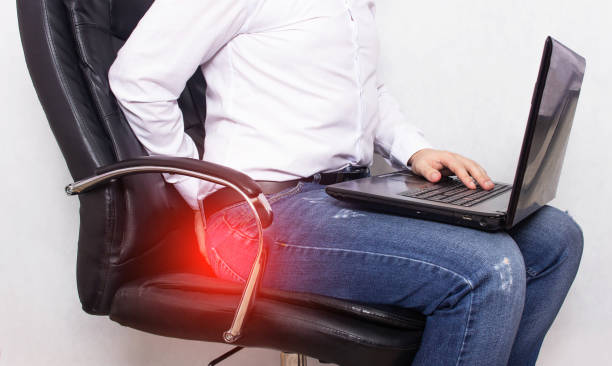
You sit down for a long meeting, a car ride, or just your usual evening on the couch, and there it is again, that sharp, nagging, sometimes burning pain near your backside. You shift, you adjust, you try another cushion. Nothing really helps. If this sounds familiar, you’re not the only one losing sleep over it. According to a peer-reviewed study published by NCBI, nearly 50% of Indians develop haemorrhoids at some point in their life by the time they reach age 50, and about 5% of the population is dealing with them at any given moment. That’s a huge number of people silently suffering, and most of them quietly assume it must be piles. But here’s the thing, pain while sitting can come from several reasons, and piles is just one of them.
So before you self-diagnose on Google at 2 AM, let’s break down what could actually be going on.
Your rear end may feel like a cushion, but the area around your anus and tailbone is loaded with nerves, small blood vessels, muscles, and soft tissue. When you sit for long hours, pressure builds up in exactly the wrong places. If something is already inflamed, swollen, or injured down there, every minute on a hard chair feels like torture.
Now, the pain itself is a clue. The type of pain, when it starts, what makes it worse, and what else is happening around it can tell you what the real culprit is.
Piles, or haemorrhoids, happen when the blood vessels around your anal canal swell up due to pressure. That pressure usually comes from straining during bowel movements, chronic constipation, sitting too long, or a low-fibre diet.
You’re probably dealing with piles if you notice:
Many patients describe it as a “heavy, throbbing” feeling when they sit, almost like sitting on a marble. If that rings a bell, it’s time to stop ignoring it. You can learn more about the condition and modern treatment options on the piles treatment page.
Here’s where people go wrong. They assume any pain “down there” is piles, start applying creams from the chemist, and waste months without relief. In reality, several other conditions cause similar pain.
A fissure is a tiny crack or tear in the skin lining the anus, usually caused by hard stool. The pain from a fissure is sharp, cutting, and knife-like during and right after passing stool. It can last for hours. There may be a small amount of bright red blood, but unlike piles, there’s no lump. Fissures can make sitting unbearable because even the slightest stretch of the area hurts.
If you feel a hot, painful swelling near your anus, often with fever or a feeling of being unwell, it could be an abscess, a pocket of pus caused by infection. Fistulas are small tunnels that form after an abscess drains. These need medical attention and won’t heal on their own with creams or sitz baths.
This one is sneaky. It happens near the tailbone (not the anus), usually at the top of the buttock crease. Sitting long hours, especially for drivers and office workers, can make it worse. You’ll feel pain slightly higher than where piles would hurt, and sometimes notice a small opening with pus or hair.
Ever fell on your bum and now sitting feels awful months later? That may be coccydynia, pain in the tailbone itself. It has nothing to do with the anus or rectum. The pain is right at the base of your spine and shoots up when you lean back in a chair.
Sometimes long hours of bad posture, tight hamstrings, or a pinched nerve (like in piriformis syndrome) cause pain that feels like it’s coming from your butt but is actually from the muscles or nerves around it.
Honestly, you can’t always tell on your own, and guessing can make things worse. A quick check by a specialist usually clears it up within minutes. Diagnosis often includes a simple visual exam, and sometimes a proctoscopy or ultrasound if needed. Once the exact cause is known, treatment becomes straightforward.
If it does turn out to be piles, you don’t have to jump straight to surgery. Modern medicine has moved on. A procedure called HAE (Haemorrhoidal Artery Embolization) is now available in India, which treats piles through a pinhole-sized entry in the wrist or groin, no cuts, no stitches, and no hospital stay in most cases. Most people walk out the same day and are back at work within 48 hours.
Book an appointment if:
Early consultation almost always means easier and faster treatment. Delaying usually turns a small Grade 1 pile issue into a Grade 3 or 4 case that needs far more intervention.
Pain while sitting is not something you just “adjust to.” Your body is telling you something is off, and the earlier you listen, the sooner you’ll get back to normal life, long flights, family dinners, long work hours, movie nights, and everything in between. Whether it’s piles, a fissure, or something else, there’s a solution for every one of them today. At Dr. Gangwani Vascular Clinic, you get access to advanced non-surgical options like HAE that treat the root cause without scars, stitches, or long recovery. If you’ve been putting this off, take that first step today. Your peace of mind (and your back) will thank you.
Dr. Gangwani Vascular Clinic, 302/TGN SQUARE 3rd floor Chandawarkar lane Borivali west Mumbai 400092
+91 9326195964
drgauravgangwani@gmail.com
Monday to Saturday: 8.30 am to 8.00 pm. For any quires & assistance please call on: +91 9082394787
Copyright 2026 – www.drgauravgangwani.com
Website Managed by SEO Discovery
WhatsApp us