

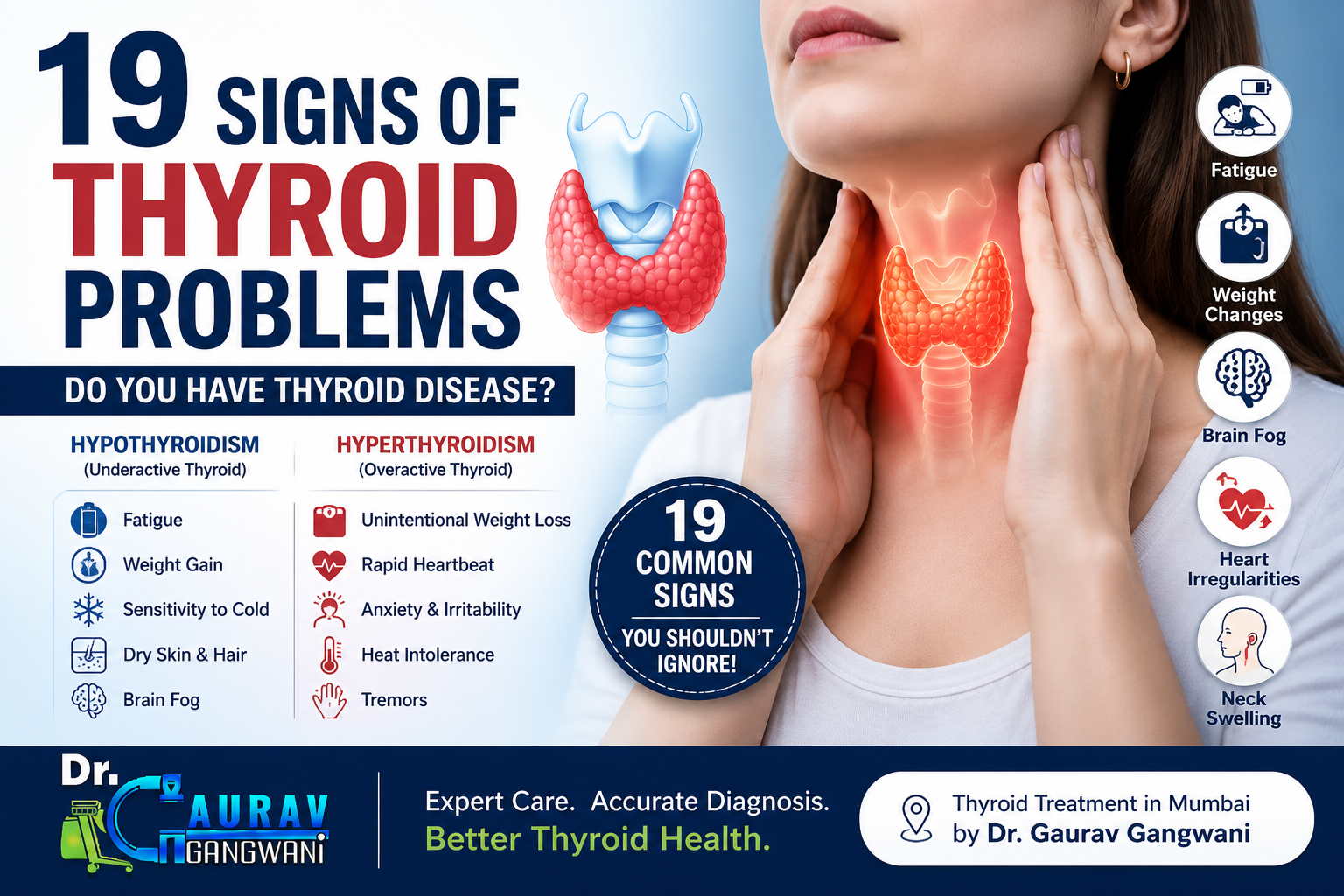
19 Signs of Thyroid Problems: Do You Have Thyroid Disease?

Share on facebook
Facebook
Share on twitter
Twitter
Share on linkedin
LinkedIn
Effects of Piles, Varicocele, and Breast Lump Treatment
19 Signs of Thyroid Problems

Table of Contents

Do you constantly feel tired, have issues with losing or gaining unexpected weight, or suffer from brain fog? These are common signs of a thyroid gland. As your body’s primary metabolism regulator, your thyroid gland plays an important role in heart, energy, and mental clarity.

At Dr. Gangwani’s Vascular Clinic, we help you move past the guesswork. Whether you’re looking for expert guidance or seeking thyroid treatment in Mumbai, identifying these symptoms early is the best way to address the root cause and restore your hormonal balance. If you recognize these patterns, it is time to look at the clinical evidence below.

Understanding the Thyroid Spectrum

Thyroid disease generally falls into two main categories: hypothyroidism (an underactive thyroid) and hyperthyroidism (an overactive thyroid). Your symptoms often depend on which way the balance is tipped.

However, the body rarely keeps these symptoms neatly organized. Some people experience a mix of signals that can be confusing. Here are 19 common signs that your thyroid might need some professional attention.

10 Common Signs of an Underactive Thyroid (Hypothyroidism)

When your thyroid slows down, your entire body seems to follow suit. Everything feels like it is running in “low-power mode.”

  • Persistent Fatigue: You wake up tired even after a full night’s sleep.
  • Unexplained Weight Gain: Even with diet and exercise, the scale keeps creeping up.
  • Sensitivity to Cold: You are constantly reaching for a sweater while others are comfortable.
  • Dry Skin and Hair: Your skin feels parched, and your hair may become brittle or start thinning.
  • Brain Fog: You struggle to focus or feel like your memory isn’t as sharp as it used to be.
  • Depression or Low Mood: Feelings of sadness or apathy can often be linked to hormonal imbalances.
  • Constipation: A slow metabolism often leads to digestive sluggishness.
  • Muscle Aches: You might feel stiffness or weakness in your joints and muscles without a clear injury.
  • Heavy Menstrual Cycles: Irregular or unusually heavy periods are a common red flag.
  • Slow Heart Rate: Your pulse may feel slower than normal.

9 Common Signs of an Overactive Thyroid (Hyperthyroidism)

When your thyroid goes into overdrive, your body is effectively stuck in the “on” position, burning energy much faster than it should.

  • Unintentional Weight Loss: A dramatic decrease in weight, despite normal or more frequent appetite.
  • Tachycardia: The term refers to a rapid or irregular heartbeat, even if you’re not at your desk.
  • Psychological Hyper-arousal: Psychological hyper-arousal can be described as a feeling of anxiety, anger, or irritability without a clear cause.
  • Heat Intolerance: The cause of heat intolerance is excessive sweating and an inability to endure hot temperatures comfortably.
  • Fine Tremors: A noticeable or tangible shaking of the hand or fingers.
  • Increased Bowel Frequency: A rise in Bowel Frequency, more frequent diarrhea, or digestive transit.
  • Physical exhaustion: The paradoxical fatigue that comes from your body running on “high” for too long.
  • Insomnia: Having difficulty establishing or staying asleep due to excessive stimulation of the system.
  • Goiter development: The physical swelling can be accompanied by the sensation of fullness at the neck’s base.

Why You Should Not Ignore These Symptoms?

It is easy to blame these symptoms on stress, aging, or a busy lifestyle. However, persistent changes in your health are your body’s way of asking for help.

When thyroid issues are left unmanaged, they can impact your heart health, bone density, and long-term energy levels. You don’t have to “just live with it.” Modern diagnostic tools make it easier than ever to pinpoint exactly what is happening inside your endocrine system.

At Dr. Gangwani’s Vascular Clinic, we believe that listening to your body is the most important part of the diagnostic process. We look beyond just the standard numbers to see how these symptoms are truly affecting your quality of life.

Taking the Next Steps Toward Better Health

If you recognize several items from the lists above, don’t panic. Many thyroid conditions are highly manageable with the right plan.

The process usually starts with simple blood work to check your hormone levels. From there, we can look at your medical history and specific symptoms to determine the best course of action. Whether it is a simple adjustment to your lifestyle or a more targeted treatment plan, having an expert in your corner makes a world of difference.

Don’t wait for these symptoms to worsen. If you feel like your “inner thermostat” is broken, reach out to a professional today to get the answers you deserve.

Frequently Asked Questions:

  1. Is thyroid disease something I’ll have forever?
    For many people, yes, it requires ongoing management. But once you have the right treatment, most people go back to feeling completely normal and lead very active lives.
  2. Can I just change my diet to fix it?
    Diet is helpful, but it usually isn’t enough to fix a thyroid disease on its own. It’s a great way to support your body, but you still need a doctor to check your levels.
  3. Why do I feel like I have symptoms of both?
    This happens! Sometimes your levels fluctuate, or you might have an autoimmune issue where your thyroid goes through phases of being too slow and then too fast.
  4. Does everyone with thyroid issues need surgery?
    Definitely not. Surgery is rarely the first step. Most cases are managed very well with simple medication and regular check-ups.
  5. How quickly will I feel better once I start treatment?
    It varies, but many people start noticing a real difference in their energy and mood within just a few weeks. It takes a little patience to get the dosage just right for you.
Book Appointment